
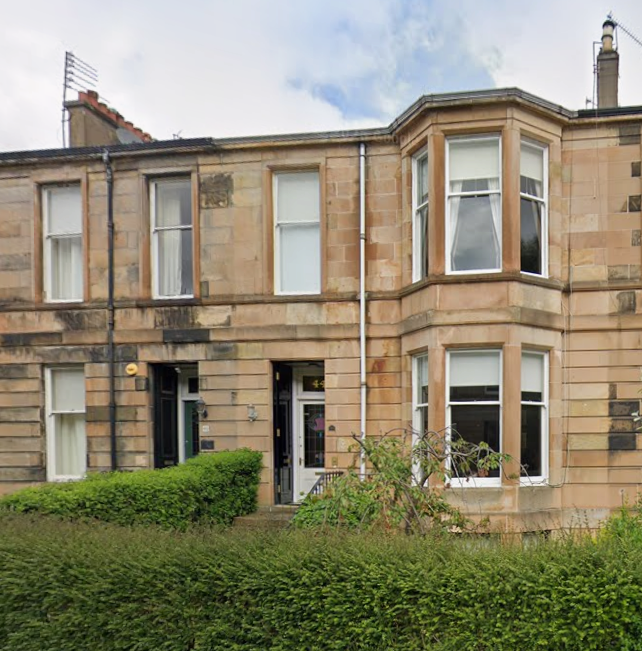
This is the story of the occupants of 44 Marywood Square, the former 21 Princes Square. The terrace was built by Robert Weir in 1878-9 but the project led to financial ruin and Robert’s tragic suicide. The houses and debts passed to his father William, but the family never recovered, as detailed in a previous blog about the Weirs. The property was subsequently owned by one John Adam Anderson.
It was also a property where if your name wasn’t William, you weren’t getting in.
William Orr
The first tenant was William Orr in 1879. William & John Orr were the sons of William Orr, an estate labourer & later grain merchant from Dundonald, and his wife, Janet Foulds. The two brothers started in the decorating business, and after apprenticeships in Ayr formed Orr Brothers in Glasgow in the late 1850s. In 1866 William won a Queens Gold Medal for his design work at the Government School of Art (later the Glasgow School of Art), and the following year his brother also won .
In 1867 they were based at 41 Cumberland St, and in 1871 William was living in the tenement at 5 Regent Park Terrace on Pollokshaws Road (now known as 1 Regent Park Square). In 1872 The Glasgow Citizen reported how the Orr Brothers received praise during the Sunday service for the singular beauty of their painting during the repair of Pollokshaws Parish Church. In a subsequent editorial the St Andrews Gazette, presumably on a quiet news day, took great offence to this use of the pulpit for advertising purposes .
By 1877 the business was based at 173 St Vincent Street & 5 Ashton Place, where John also lived, while William had moved to 8 Rosslyn Terrace, Pollokshields (above the shops running north-west from Kenmure Street). Dominic D’Angelo has found a Greek Thomson design for interior decoration marked Orr Brothers, Rosslyn Terrace. It isn’t clear if this was a design for Rosslyn Terrace or for elsewhere, but it does suggest the Orrs were doing work for Thomson.
William moved to the new house at 21 Princes Square in 1879 and stayed there at least until 1883. Around 1882 he appears to have split from John and gone into business alone, advertising as William Orr & Co at 175 St Vincent Street, with a branch at 9 Campvale, Crossmyloof. Despite much advertising in the papers in 1887, he went bankrupt in December 1888 . Yet, oddly, within a couple of months he was back in business as William M Orr & Co, thanking his customers of 30 years for their support and continuing at Douglas Villa, Hamilton Place, Langside and Mrs Fowler’s, Campvale .
He died of cancer of the throat in July 1894 while resident at 10 Albert Road, Crosshill, aged just 57. His brother John continued in business with his three sons, and the business was still going in 1947 .
William Grieve
William Grieve was resident from around 1885. He was born in Lauder, Berwickshire in 1845, the son of a mason, but trained as a draper. He moved to London initially where he met his wife, Ann Muxworthy from Devon. They married in Southwark in 1871, then moved to Glasgow where they had seven children, although three of the last four died in infancy. Those latter children were mostly born in the three years they were in Strathbungo, although the last was after a move to the villa Elmbank at 208 Nithsdale Road (confusingly sometimes known as 48 Nithsdale Road, Pollokshields).
The drapery business
William worked for a while in London, but by 1877 was in Glasgow working for David Kemp & Son. David Kemp started his business making and selling shawls in 1832 and it grew into a nationally renowned business, expanding to produce mantles, dresses and gowns for ladies, and seeking out the latest fashionable designs from London and Paris. His store, known as Kemp’s Shawl Emporium, was initially at 86, then at 37 Buchanan St from 1854. In the 1860s his son James joined, the firm becoming David Kemp & Son, and they started manufacturing their own garments at the back of the premises. William became James’ partner in the business .
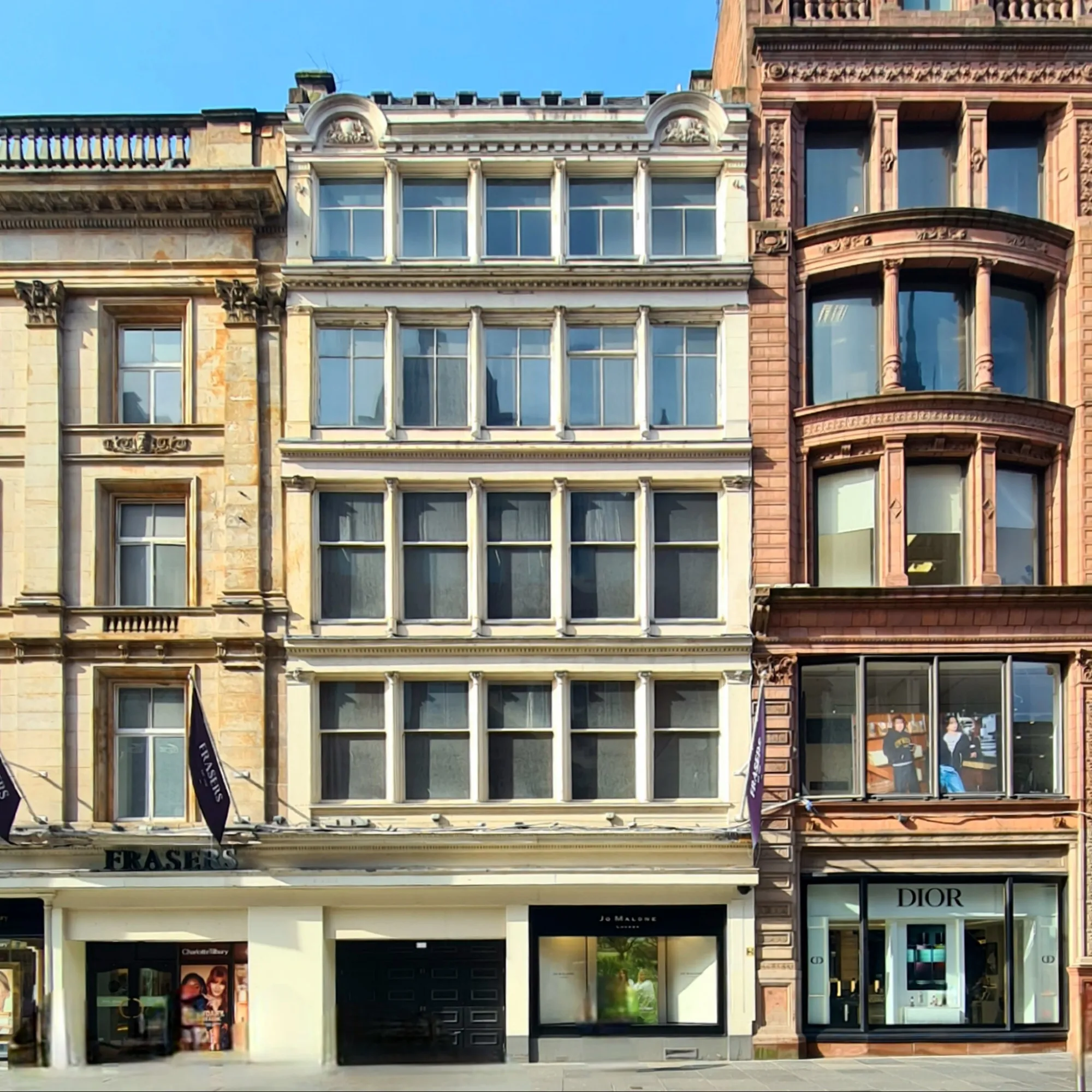
Kemp’s premises at 37 Buchanan Street, with Wylie & Lochhead’s to its right. Source: Colin M Drysdale, with permission
Disaster struck on 3rd November 1883 when a major fire broke out in the premises of Wylie and Lochhead, the furniture makers, next door in Buchanan Street. In one of the most destructive city centre fires recorded, their complex of premises between Buchanan Street and Mitchell Street were completely destroyed. The firemen were hampered by the fact that the city centre water pressure was always reduced over the weekend, and they struggled to contain the fire. Kemp’s premises immediately to the south also caught fire, although only the roof and upper storey were destroyed . The stock was damaged by smoke and water and was sold off, and Kemp temporarily moved elsewhere while the store was repaired. The fourth and fifth storeys rebuilt by Boucher & Cousland .
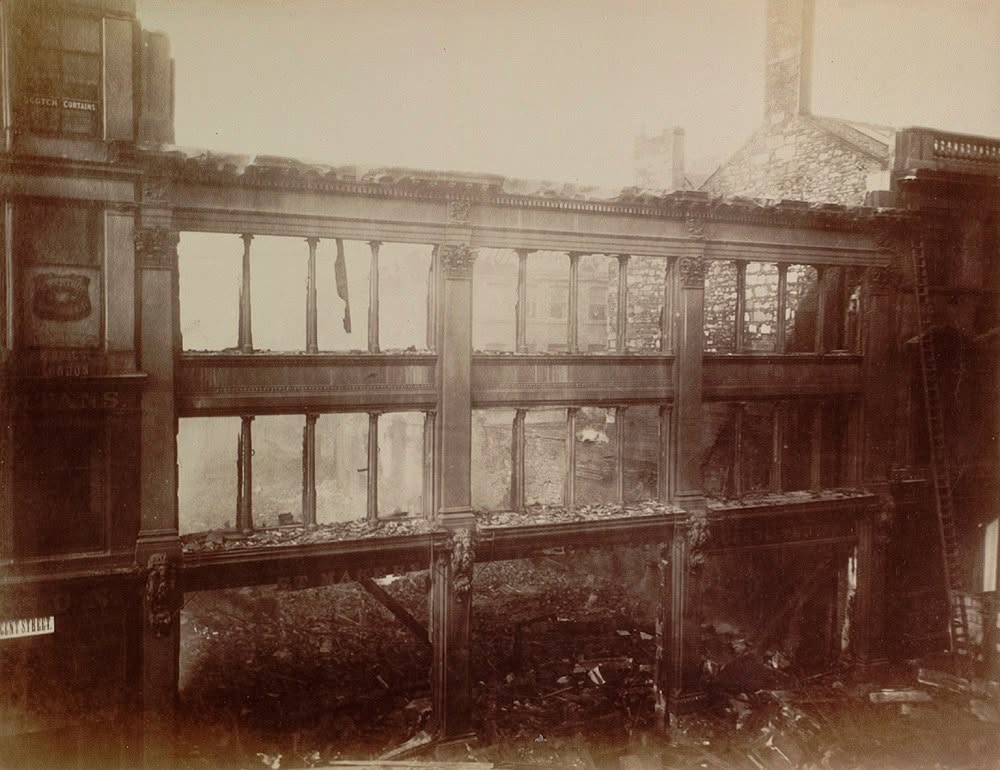
The facade is all that remains of Wylie & Lochhead, only months after they opened for business. Kemp’s store is just visible on the left. The upper two storeys were destroyed. Kemp’s shop on the lower floors survived but the stock was runied. Source: Glasgow City Archives TD 338/23/17
Once back in Buchanan Street the business got a glowing report in the 1888 trade book, Glasgow of To-day :
Messrs. David Kemp & Son, Silk Mercers, Mantle and Costume Manufacturers, &c., 37, Buchanan Street.—
One of the most prominent and attractive of the notable commercial establishments of Buchanan Street is that controlled by Messrs. David Kemp & Son. This distinguished house was founded in 1832 by Mr. David Kemp, now retired, and under his name and management it progressed in magnitude of operation and influence of reputation. About twenty years ago Mr. Kemp assumed his son as partner. The present title was then adopted, and the career of the firm since that date has been one of continuous and uninterrupted prosperity. The premises are entirely the property of the Kemp family.
They comprise a most extensive and stately block of five large and commodious floors, with a fine street frontage, great depth, and splendid accommodative capacity. The interior is a perfect study in the several details of convenience, commodiousness, and beauty of appointment. Each department is separate and distinct from its neighbours, but all share alike in completeness of equipment. Messrs. Kemp & Son have developed one of those veritable trade palaces of which there are not a few in Glasgow, though certainly none to surpass this.
At the rear of the principal floors of showrooms is an extensive factory of splendid equipment and capacity. Here the various and important productive operations of the firm are carried on, notably the making of mantles, costumes, dresses, millinery, &c., for which the house is famous. All these workrooms are spacious, airy, and well-appointed, and are populous throughout the working hours of the day with a busy and highly efficient operative staff, under whose deft fingers the pliant material or fabric assumes those countless shapes and forms so irresistibly attractive to the firm’s host of lady patrons in the warerooms close by. All the work done here is of the very highest and best class, for the status of this eminent house is among the foremost of its kind in Great Britain. Messrs. Kemp’s was formerly a shawl warehouse, famous in all parts of the country in that particular line.
The great specialities of the house, for which it has won a national reputation, are mantles, costumes, millinery, lingerie, silks, dress goods, shawls, and furs. The firm make an exhaustive study of ladies’ dress in its every phase and feature, and they justly pride themselves upon the minuteness with which they exemplify every detail and particular of the costumier’s art. They display the very latest and most select novelties of Paris and London. A special lady artist is retained to sketch for the benefit of customers every novelty that makes its advent in the world’s great centres of fashion ; and no trouble or expense is spared by the house to afford its patrons every facility possible. The fitting-rooms, situate on the upper first floors of the establishment, are simply models of comfort, convenience, and elegant appointment. Messrs. Kemp hold, altogether, one of the largest, most valuable, and most select stocks of superior goods to be found in Great Britain, and employ, in all, a regular staff of about two hundred and fifty hands.
The firm of Messrs. David Kemp & Son have enjoyed for more than half a century a commercial reputation of the highest order. The founder of the concern was famous for his great taste and sound judgment in all matters relating to the trade, and received a medal as one of the jurors of the Great Exhibition of 1851. The mantle of mercantile ability and success so appropriately worn by him has descended upon the shoulders of his son, Mr. James Kemp, a Glasgow citizen of known worth, and a former member of the City Council. He is ably assisted by his partner, Mr. W. R. Greive, whose long experience of the best houses of London and Paris has been invaluable to the firm. By these gentlemen the business is now conducted with conspicuous capability ; and in their hands the reputation of the house and all its commercial affairs are sure of the maintenance and proper administration necessary to the due preservation of every one of its honourable characteristics.
The evolution of Frasers Department Store
Kemp’s business continued, but was finally liquidated in 1928 due to competition from the rapidly expanding McDonalds department store immediately to their south. Their northern neighbour, Wylie & Lochhead had survived the fire, built a new store designed by James Sellars, and gone on to great success. When Kemp closed Wylie & Lochhead took over the building. In the 1950s both McDonalds and Wylie & Lochhead were bought by House of Fraser and they merged in 1966, trading as McDonalds, Wylie & Lochhead. In 1975 the store was rebranded as Frasers, and the original Frasers store on the opposite side of Buchanan Street was closed. Frasers continues to occupy the site; the premises of McDonalds, Kemp and Wylie & Lochhead are all now part of the one store .
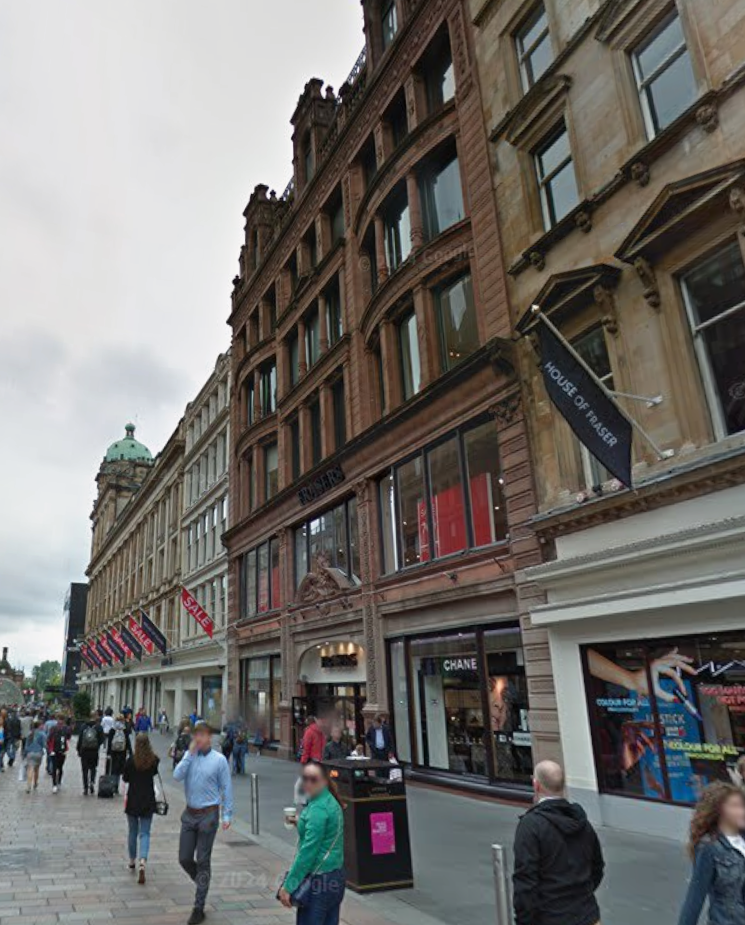
Frasers on Buchanan Street is an amalgamation of several stores, including the 1903 rebuild of McDonalds in the distance, the cream Kemp’s and the red sandstone of Wylie & Lochhead. The store to the right of Wylie’s is also now part of Frasers. Source: Google Streetview
W R Grieve
By 1892 William had branched out on his own, and opened a store at 226 (and later 228) Sauchiehall Street – these are now Mac’s cobblers, and Ladbrokes. Around 1903 he moved further down the street to 450 Sauchiehall Street, a new building designed by Watson and Mitchell in 1899. William died in 1906, but his Strathbungo-born son William Robertson Grieve continued the business.
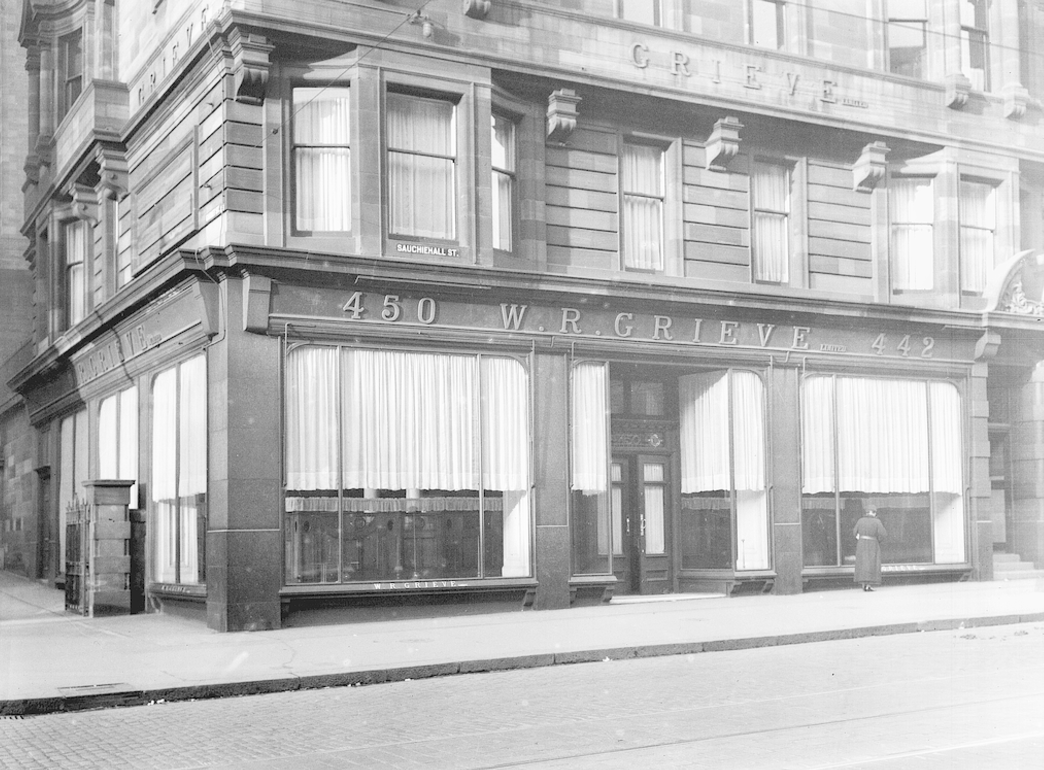
W R Grieve shop at 450 Sauchiehall Street in 1939, possibly after closure and prior to alteration. Source GCA C7084
His son married Dorothy Crichton, who lived opposite them on Nithsdale Road in Pollokshields, in December 1916, but he was sent to France in March 1917, and was killed only a month later in the Battle of Arras. The University of Glasgow has a biography of him in their roll of honour .
William attended Glasgow Academy and Dollar Academy before leaving school in 1901, aged 16. He later became a member of the University Officer Training Corps and managing director of his own company WR Grieve Ltd which operated a series of warehouses in Glasgow and was headquartered at 450 Sauchiehall Street. He was a skilled cricket player and even played in some Scottish matches.
In June 1912, William was commissioned into the 7th (Blythswood) Bn. Highland Light Infantry of the Territorial Army as a 2nd Lieutenant. When the First World War broke out, William was promoted to the rank of temporary Captain in the 2/7th Battalion which carried out Home Defence in Glasgow and Dunfermline. However, after the passage of the Military Service Act 1916, William was made available for front-line service.
On December 9th 1916, before he could be sent abroad, William married a Miss Dorothy Crichton, who had lived across the street from him on Nithsdale Road. The two were married just four months before William relinquished his temporary rank and was sent to France on the 20th March 1916. On the April 28th 1917, after barely a month in France, Lieutenant William Robertson Grieve was recorded killed in action while fighting in the Battle of Arras. To this day he has no known grave and his name is inscribed on the Arras Memorial at Faubourg D’Amiens Cemetary in Arras. He was 31 years old.
On October 21st 1917, almost six months after William’s death, his wife Dorothy gave birth to their son, who was named William Robertson Grieve in honour of his father and grandfather. William’s son graduated from the University of Glasgow in 1939 and became Lord Grieve, a judge in Scotland’s Supreme Courts .
Who took over control of the business of W R Grieve after William’s death is not clear, but it was still trading in Sauchiehall Street in 1938. The building is now occupied by The Bank of China and a fast food store, but there are three ghost signs on the building that still read “Grieve” .
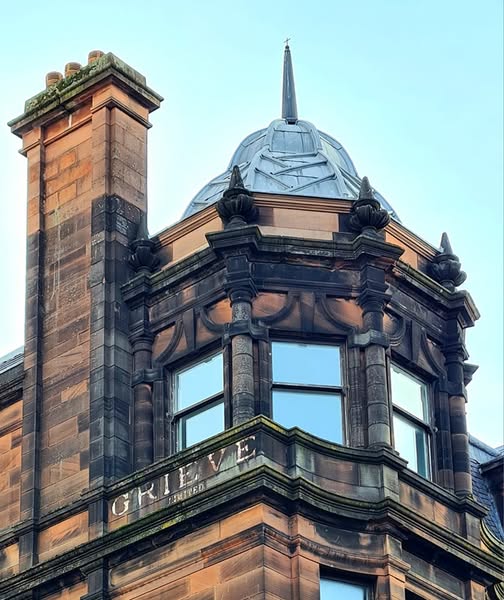
Ghost sign at 450 Sauchiehall Street. Two other Grieve signs are also still visible lower down, Source: Colin M Drysdale, with permission
The Rogers
The Rogers moved in around 1890.
William Wood Roger was the son of George Roger, an Original Secessionist Church minister in Auchinleck, and Ann Hunter Wood, of Ayr. He was born in 1848, the second of six. Both his parents died in the 1860s, and in 1871 he was living with and looking after four younger siblings in a flat in Kier Terrace (Keir Street), Pollokshields, with the aid of his paternal aunt, Christina. By 1881 he was a coffee and spice merchant living at 44 St Vincent Crescent with his sister Jane.
In 1888 he married Mary Jean Alexander of Edinburgh and around 1890 they moved to 21 Prince’s Square. In the 1891 census they were being visited there by several relatives including his brother John. Over the next five years they had three boys.
His maternal uncle Hugh was an established merchant in Glasgow dealing in coffee as Hugh Wood & Co. However he never married and when he retired, around 1882, he handed his business to his son-in-law William. Hugh retired to Hampstead in London. William’s brothers John & George moved to Johannesburg as merchants, and South African trade became a significant factor in the business. Once again Glasgow of To-day (1888) has something to say about the business :
HUGH WOOD & Co., Coffee, Spice, and General Produce Merchants, 30 & 32, Arden Street, Glasgow.
A firm of produce merchants that, for a period of forty years, has held pre-eminent rank in the commercial circles of Glasgow is the one mentioned at the head of this short notice. The business in question was founded by Mr. Hugh K. Wood, a gentleman who some time ago retired from the concern in favour of his nephew, Mr. William Wood Roger, the present head of the house.
The business has ever been one of a rapidly developing character, and at the present time there are certainly no signs of diminution in the ratio of mercantile progression. Large premises are necessary to accommodate the extensive stocks held and to admit of the various functions of administration attaching to so widespread and influential a business. The establishment is in every respect suitably appointed ; the handsome offices, spacious warehouse, and sample rooms having an exceptionally well-equipped and appropriate appearance.
The stocks held embrace many of the leading lines in general produce, noticeable features being coffees and chicory, barleys, rices, peas, oatmeal, flour, sago, arrowroot, semolina, tapioca, spices of all kinds, butterine, and a considerable variety of drugs and drysaltery goods. In addition to a vast home trade, extending throughout the length and breadth of Scotland and in Ireland, Messrs. Hugh Wood & Company possess a most valuable export connection, the principal sphere of foreign operations being South Africa and Canada.
Mr. Wm. W. Roger is a gentleman of wide business experience and in every way well adapted to the successful proprietorship of a large trading enterprise. He pays special attention to the prompt and accurate execution of all orders, and by his undoubted energy and ability he has maintained the high and unsullied reputation which his house for the past forty years has enjoyed in the trade. During the long existence of the business the house has been closely allied to the commercial prosperity of Glasgow, and, as we have already indicated, no effort is spared to render the establishment well deserving of a continuance of that support which has ever fallen to its lot.
In 1892 the Dundee Courier reported William as a joint investor in “The Ship Dalcairnie Company”. The SV Dalcairnie was a steel-hulled fully rigged sailing ship built that year. It was common for merchants to invest in ships as syndicates as it reduced the individual risk when a ship was inevitably lost somewhere. It isn’t known if the Rogers still had money in the ship when it ran aground and sank off Brazil carrying South Wales coal in 1907 .
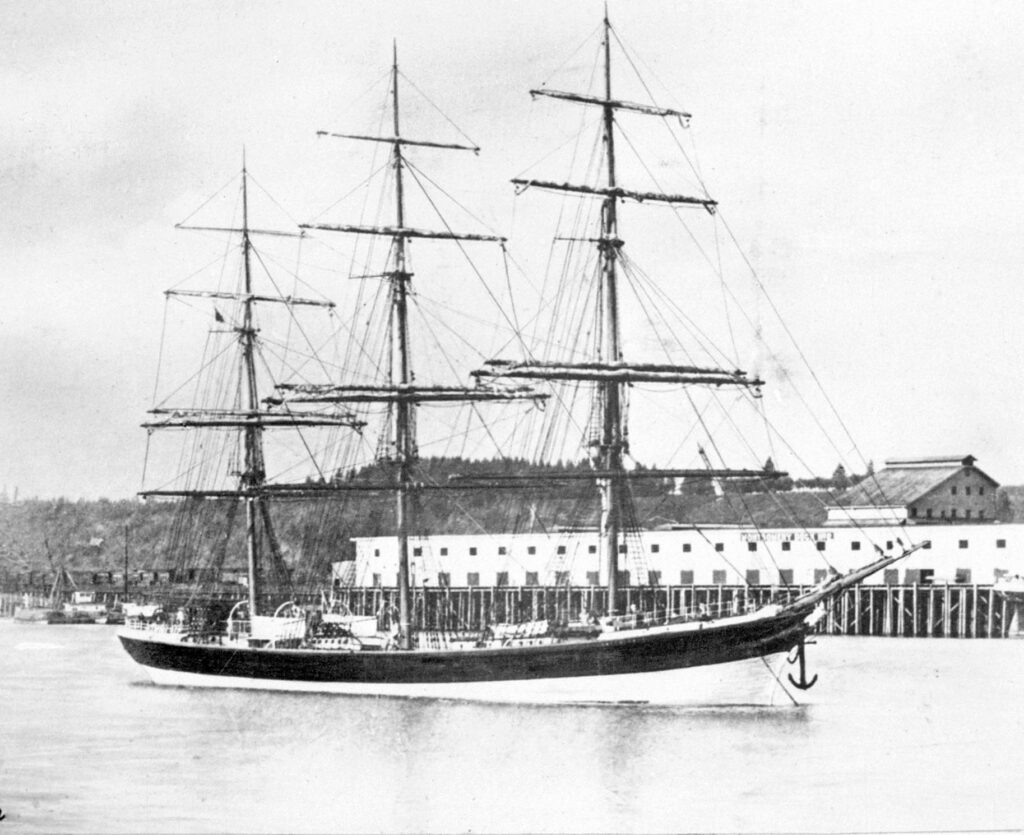
SV Dalcairnie in Australia. Source: Clydeships & State of Victoria Archives
William died at the age of 50 while at Auchinleck, a house in Johannesburg, in 1898, presumably while visiting his brothers. His brother John died the following year in London. Their uncle outlived both of them, dying in London in 1906. William’s widow Ann left the house around 1904, possibly moving to Dunblane. She died in an Edinburgh nursing home in 1944.
The house was advertised for sale part way through the Rogers’ tenancy in 1896. This was the second time the owner had tried to sell; it had previously been advertised in 1882 for £1050, but this time was listed at £950, £100 less than 14 years earlier. House price inflation seems to be a new phenomenon. We don’t know if the Rogers bought it; the first known owner occupier was the next resident, William Miller.
William Miller
William Miller was born in Glasgow around 1839 and married Jane Smith in 1865 at the High Church (the cathedral). They had six children, four girls, two boys. They settled first in the east end, then Cathcart, before renting a new house at 39 (now 33) Queen Square, Strathbungo in 1885, as tenants of the builders Alexander Thomson and Robert Anderson.
They then moved one street over to purchase outright 21 Princes Square around 1904. William worked as a muslin manufacturer and East India merchant. I can find little trace of his business, Miller & McGregor, other than William continuing the business alone after 1894. He died at Princes Square in 1925, leaving an estate of almost £15,000. Ownership of the house passed to his three younger daughters, Jane, Agnes and Janet.
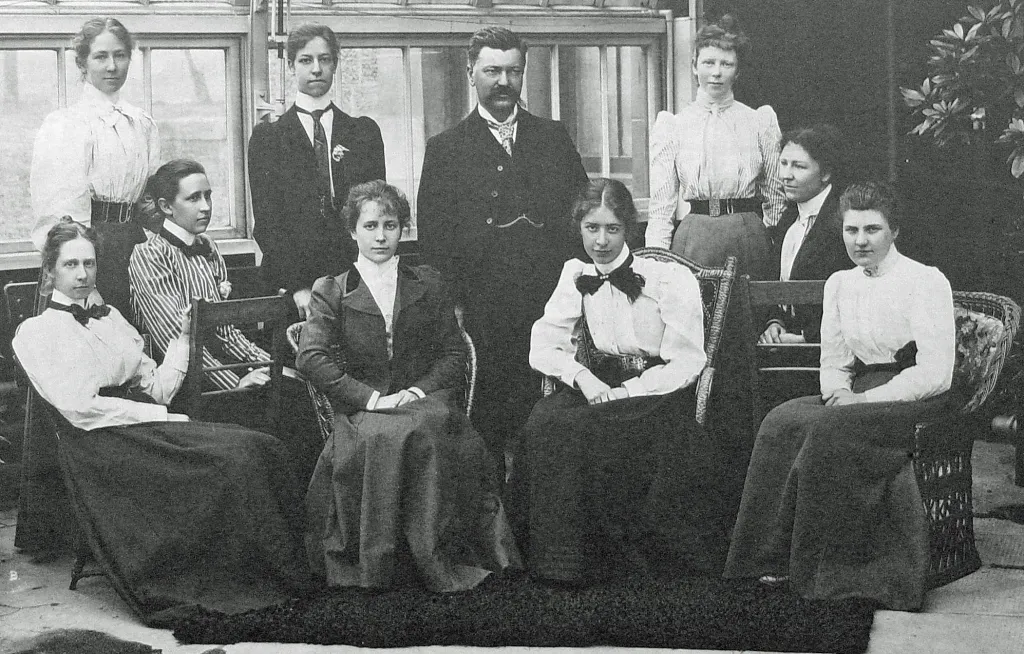
Female medical staff at Glasgow Royal Infirmary c 1904. Janet Miller is seated fourth from left. Source: Glasgow City Archives
Dr Janet T Miller was an early female doctor. She qualified in medicine and was on the medical staff at the Glasgow Royal Infirmary in 1904. She was appointed senior medical assistant at the East Poorhouse, Dundee, in 1910. In 1919 she was lecturing in Glasgow and claimed 50% of lower-class children in the city had rickets .
The Rombachs
The PO Directories from 1927 to 1941 report a Miss Rombach at 21 Princes Square, finally breaking the William tradition. This is rather confusing, given that Miss Rombach was not a Miss, didn’t live there, and was already dead.
Miss Rose Elizabeth Rombach was born in Wick in 1866 to a German watchmaker father and a Scottish mother, one of eight children. Her brother David Sutherland Rombach was born in 1874, after the family moved to Glasgow. By 24 Rose was already a restaurant manager working for Miss Cranston, and her first tea room under her own name opened at 176 Hope Street in 1910. The following year she had also opened a restaurant on the first floor of the Corn Exchange at the corner of Hope Street and Waterloo Street. It was known as Miss Rombach’s Lunch and Tea Rooms, and was a minor rival to Miss Cranston, who already had several tea rooms in the city centre.
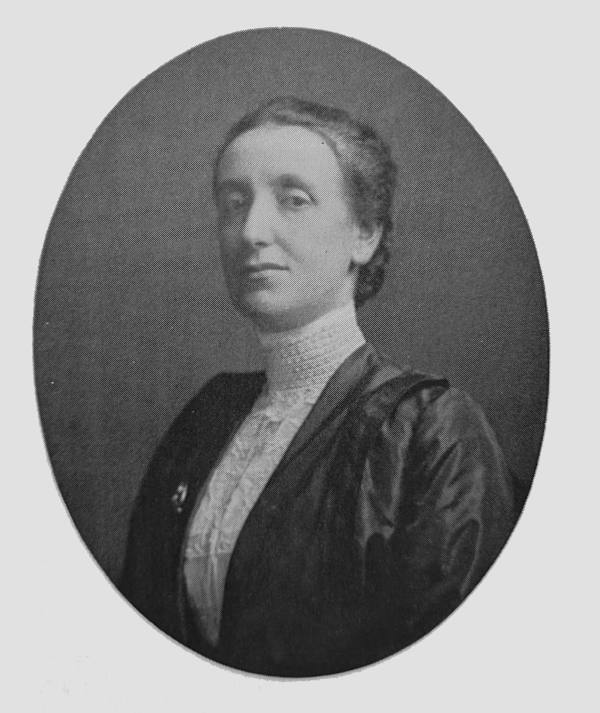
Miss Rose Rombach. Source: Tea and Taste, Perilla Kinchin
She didn’t remain Miss Rombach for long, marrying an accountant, William Davidson Hall, in 1912, and appearing to have had two children soon after. Although she died in 1927, the tea rooms continued in operation at least until 1941, and possibly until the Corn Exchange’s closure and demolition around 1959 .
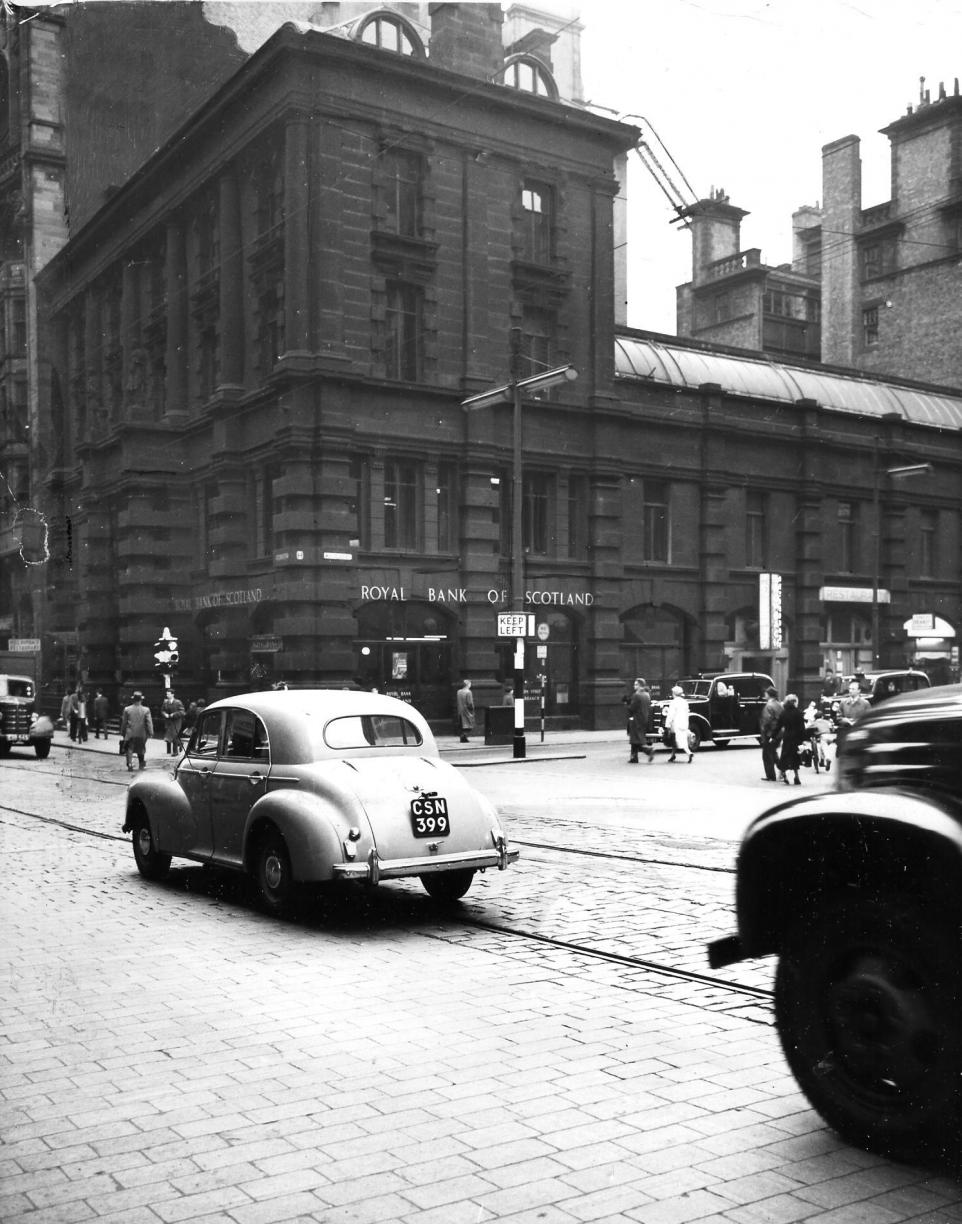
The Corn Exchange on the corner of Hope and Waterloo Streets in 1959 just before closure. The sign for the restuarant can be seen on the Waterloo Street frontage on the right. Source: Glasgow Herald
However Miss Rombach didn’t ever live in Strathbungo. It was David Rombach, her younger brother and her partner in the tea rooms, who continued the business after her death and lived at the house at 21 Princes Square (briefly to become 44 Princes Square, and then 44 Marywood Square thereafter) from around 1927. (Perilla Kinchin suggestes in her book that Miss Rombach sold the business to her brother on marrying .)
In his earlier years pre the Great War David had played as a full back for Airdrieonians, and had been team captain. When Airdrieonians won the Scottish Cup in 1924, the team celebrated in Miss Rombach’s tea rooms. David married Margaret Reekie in 1921 and may have had a son (Balfour) in 1933. Margaret was involved in a tragedy in 1932 when she was injured in a car crash at the junction of Kings Park Avenue and Aitkenhead Road. Her mother Jean Reekie died in the accident . One witness claimed the crash was so violent one vehicle somersaulted over the other, and both were wrecked .
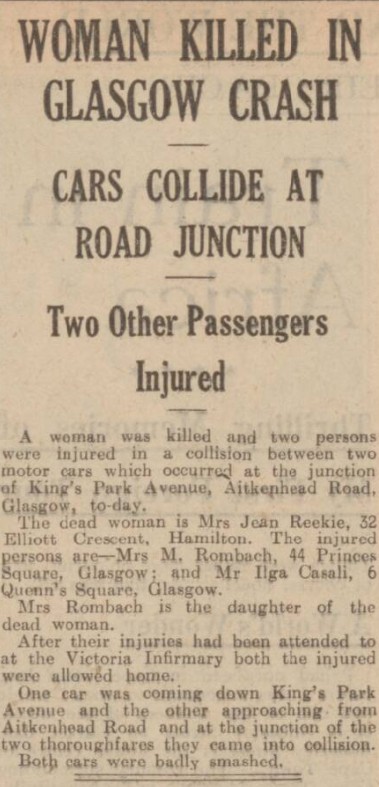
It is unclear if Mr Casali of Queen Square, Strathbungo, was a friend, or in the other car. Dundee Evening Telegraph, 10 Jun 1932. Source: BNA
David died in 1943, Margaret in 1962. It remains unclear why the PO Directory repeatedly recorded the occupant as Miss Rombach, perhaps a reference to the business name rather than David, the occupant. Or perhaps he was embarrased he wasn’t called William.
Additions and corrections welcome.
Leave a Reply