
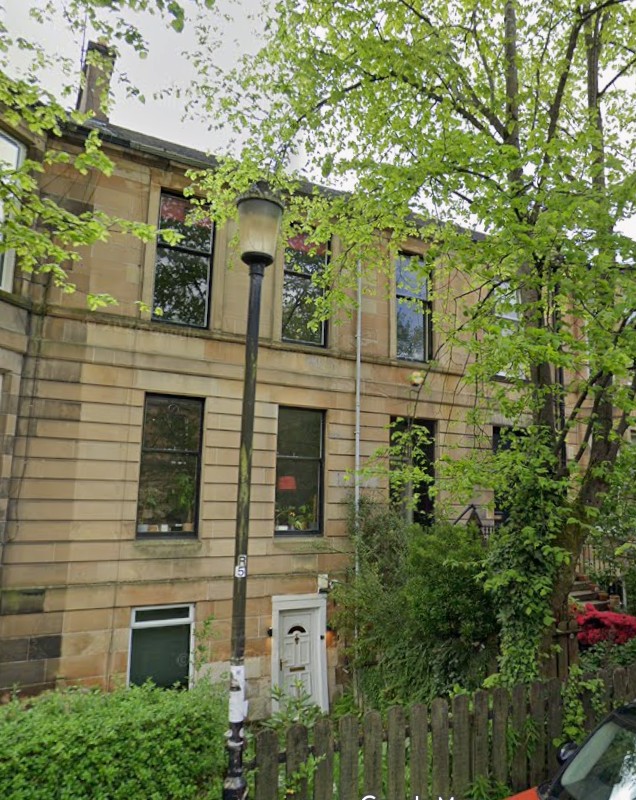
This is the story of the occupants of 21 Marywood Square, formerly 42 Princes Square.
James Robertson
The long terrace on the south side of Marywood Square was built c.1884-5 and in the 1885 valuation roll the entire terrace was listed as belonging to James Robertson, a mason and builder living in Pollokshields. He first advertised the houses for sale or let in the spring/summer of 1884. Yet in 1891 he went bankrupt , he died in 1893, and by 1895 the valuation roll notes the entire terrace was back in the ownership of William Stevenson, the quarrymaster and original developer of Strathbungo.
John & Elizabeth Anderson
John’s grandfather was a bookseller in Dumfries. His father Robert Wright Anderson took up printing and moved to Glasgow to work as a foreman with the Glasgow Herald before striking out in business on his own as a letterpress printer . His uncle Sir James Anderson also began training in printing, but jacked it in to go to sea. He achieved fame as the Captain of the SS Great Eastern who oversaw the laying of the first successful transatlantic telegraph cables in 1865-6 .

The Bailie caricature of Robert Anderson, letterpress printer. Source: TheGlasgowStory
John and his brother Robert took over their father’s printing business on their father’s retirement. The firm is described in Stratten’s 1891 trade directory thus:
The old-established and very influential house designated above has occupied an honourable position in the trade it so well represents for over half a century. This extensive concern is now conducted by Messrs. John and Robert Anderson, sons of the original founder, Mr. Robert Anderson, and its business will give a fair idea of the progress of the trade in Glasgow.
The original site of the house was at 85, Queen Street, but, owing to the demand for more space and enlarged facilities, it was subsequently removed to the above address. The Ann Street premises now include a capacious warehouse on the first floor, and a letterpress department, counting-house, and suite of private offices on the floor above. The fittings of the latter are of the most modern and comfortable kind, with every convenience for the control and dispatch of business, including telephonic apparatus. The printing house is also perfectly modern in its equipments, and is equal to the production of first-class work in all departments, whether bookwork or general printing. In the warehouse below heavy trade stocks are stored.
In the City the house is a favourite one, on account of the high reputation it has so long enjoyed — its leading position in the trade and the enterprising promptitude of its management. Several special lines and specialities of the firm are important, none perhaps more so than its “copying mixture”, manufactured by themselves, and guaranteed to give perfect copies, after having been printed over a number of years, all printed matter copying quite clearly along with any matter that may be written in ordinary copying ink on the printed forms.
Large staffs of assistants are engaged in the general work of the firm, and the partners in person supervise everything. By their skill and attention — progressive spirit and judicious catering for the needs of their clients — they have fully sustained their widespread robert andersonreputation, and gained an honourable standing among the go-a-head and successful business men of the great City, with whose progress their firm has been so closely and so long connected.
The Ann (now Midland) Street warehouse appears to have fallen victim to the expansion of Central Station in the early 1900s.
John Anderson was born in Glasgow in 1846. He married Elizabeth McLeod MacMillan in 1869. They lived first in Norfolk Street, moved to Kenmure Street, and c 1885 moved to 2 Princes Square, then in 1887 to 42 Princes Square, where Adam, the last of their nine children, was born in 1889. His wife died at Princes Square a couple of years later on 6 May 1891, aged only 43.
After her death John moved to Royal Terrace in Crosshill (the tenement overlooking Queens Park from Queens Drive, before Victoria Road) although in 1911 he died at 11 Sutherland Avenue in Pollokshields. Sadly, he had outlived all but three of his children.
The addresses in Royal Terrace are a mass of confusion. John lived at 12 and/or 13, while his widowed mother lived at 10, sharing the address with an unrelated Frederick Anderson, an Irish chandelier manufacturer, and next door to Robert Anderson at No 9, a partner in J & R Anderson, painters & decorators (and a Glasgow councillor) but also unrelated, while John’s brother Robert lived behind them at 12 Albert Drive (now Road) along with numerous more unrelated Andersons on the street. It seems everyone in Crosshill was called Anderson.
A typical street conversation in Crosshill c.1900:
There is a memorial to his father in Glasgow Necropolis, by J & G Mossman with rather Greek Thomson design elements, while there is a memorial to John and his family in Old Cathcart Churchyard.
Paul Campbell
Paul Campbell was born in Paisley in September 1857, the son of a woollen scourer. He married a farmer’s daughter from Glamis, Mary Ann Dove (b. 1861) in her home town in 1881, and the couple began a family. They lived at a number of addresses, notably Gowanlea (1885) and then Strathmore (1890), both houses on Dunterlie (later Carlibar) Road in Barrhead. Soon after, they moved to 42 Princes Square, where their sixth and final child, Gertrude, was born in May 1892. By 1900 they were at 185 Nithsdale Road, Pollokshields, which they also called Strathmore (reflecting Mary’s Glamis origins), and then at 1 Woodrow Circus in Pollokshields in 1905. He died there in 1914.
That final address is an odd coincidence; it was previously the home of James Robertson, the builder of his Princes Square house.
Paul specialised in, amongst other things, ladies’ companions. However that’s not a euphemism, but a portable sewing kit no lady should be without. He was, primarily, a moulding and glass merchant, his trade described in the PO Directory as “carvers and gilders, manufacturers of mirrors, show cards, and picture frames, photoframes, in plush, leather, and other artistic fabrics, fancy goods, &c.; wholesale dealers in paintings, oleographs, and chromos, fine art publishers; ; 63, 65, 67 and 69 Waterloo st.; works, 48, 50 Wellington Lane, and 97 West Campbell St”.

Three examples of Victorian ladies’ companions, portable sewing kits.
His firm appeared in Who’s Who in Business in 1914 thus:
CAMPBELL (PAUL) & SONS, Ltd., Fine Art Publishers, Photo-Frame Manufacturers and Picture Frame Makers, Silvergrove Works, Silvergrove Street, Glasgow. London Showroom: 3 and 4, Australian Avenue, E.C. (open by appointment only). Hours of Business: Glasgow, 9 a.m. to 6 p.m.; Saturdays, close at 1 p.m. Established in 1888 by Paul Campbell as Paul Campbell & Sons, joined by Daniel Browning in 1889. Incorporated as a Limited Company in 1898. Managing Directors: Paul Campbell, Daniel Browning. Premises: Extensive, well-equipped Works in Glasgow. Staff: 250 to 300. Specialities: Photo Frames made for all the world. Mirror Brackets, Jewel Cases, Ladies’ Companions, Glove, Handkerchief and Trinket Sets, &c., Plain, Fancy and Metal-edged Boxes, Show Card and Picture Frames; American Style Antique Oak Frames. Registered Trade Mark: ” Gang; Forward.” Connection: United Kingdom, Colonial, Foreign. Telephones: No. 58 Bridgeton (two lines). Telegraphic Address: ” Plush, Glasgow.” Bankers: National Bank of Scotland, Ltd. (St. Rollox). Mr. Browning is one of the three representatives of the Employers for the Scottish Area on the Paper Box Trade Board. Clubs: (Mr. Browning) Glasgow Liberal.
Although the business was called Paul Campbell & Sons, I did not find any reference to any partner other than Daniel Browning. Paul’s son LCpl George Dove Campbell was killed at the Battle of Arras in April 1917. The firm was wound up in 1924. His wife died in 1934. There is a memorial to the three of them, “Erected as a tribute of esteem by his employees and friends” in Eastwood cemetery.
The firm did make the press on a couple of occasions. In 1902 George Mackintosh Bridges, a travelling salesman for the firm, was found shot dead in a London hotel room, with two gunshots to the head . A verdict of suicide was returned. Around September 1907 the firm wrote to the Ratner Safe Co to inform them their safe had resisted an attack with gelatine, and Ratner used the incident in their advertising .
William Fisken
William Bryson Fisken was the son of Peter Fisken from Perthshire, a farmer at Orchard Farm, Eastwood. He was the eighth of ten children by Peter’s second wife Janet Johnston. He became a spirit dealer, with premises at 59 Hope Street. His father died in 1882 and he married Isabelle Treasurer in 1887. They left the family home at 12 Ure Place and settled initially at 26 Annette Street in Govanhill, where they had two daughters, Isabella and Janet. However they parted in 1895 and William divorced his wife in 1900 on the grounds of her drunkenness and infidelity. He alleged she had taken to drink when Janet was only two .
William came to 42 Princes Square around the time of his divorce proceedings and stayed until at least 1905, then moved over the railway line to Mariscat Road, and later to Hyndland Road where he died in 1918. The 1901 census gives us some idea of his family circumstances, with thirteen people living in the house. William and his two daughters shared the home with his unmarried sister Jane, his widowed sister Agnes Harper and her four children, his maternal aunt Miss Jeanie Johnston, and his nieces Jessie & Isa Jackson who were possibly orphaned. They had an 18 year old domestic servant, L Williamson. Quite a household.
Harry Williams
Harry Williams was born in England around 1867. He served a five year apprenticeship at the Coalbrookdale Company in the Ironbridge Gorge in Shropshire, then left for Australia in 1888 where he worked for a number of firms in Victoria. In 1897 he joined London-based Fraser & Chalmers as an engineer, and then became assistant manager at McOnie, Harvey & Company in Glasgow. In 1901 he was living at 13 Regent Park Terrace (now 1 Marywood Square) in Strathbungo and working as an engineering works manager .
Around 1906 he moved up the road from tenement to house at 42 Princes Square, with his wife Sarah (nee Ward) and their three children, Harry Bertram & Dubie May (both born in Australia) and Leslie (born Glasgow). He became managing director and chairman of John Cochrane (Barrhead) on the death of Mr Cochrane (who, incidently, was the husband of Kate Cranston, and a tenant of William Stevenson, at Hous’hill). Harry died in December 1927 while conducting business on behalf of Cochrane’s in Paisley. His wife died in Natal in 1938. They are both buried in Eastwood Cemetery.
Harry Jnr lived at 42 Princes Square, as a shipbroker and coal exporter, though he later moved to Dalziel Drive.
Ownership
William Stevenson passed ownership of 37, 41 & 42 Princes Square to his eldest daughter Jane, who had married mining engineer George McCreath. Ownership remained in Jane’s name, probably until her death in 1931. She and her husband lived next door at 41 (now 23).
The Highets
The Daily Record reported the marriage of Catherine, only daughter of Mr & Mrs Highet of 21 Marywood Square in January 1935. John Barr was also a resident, perhaps a lodger, and a director of A Stuart Smith, Ltd, who appeared to be money lenders of some sort.
James Pringle
James Pringle was a tailor and draper listed at 21 Marywood Square in the 1938-9 Glasgow PO Directory, but I know nothing else about him.
Dr Leslie Woodhouse Price
Dr Leslie Woodhouse Price moved to Glasgow in 1929 and was resident at 21 Marywood Square in 1941, although he returned to London shortly after. He was a pathologist, and director of pathology at the Glasgow Royal Cancer Hospital and the Glasgow and West of Scotland Radium Institute. His biographical details are taken from the BMJ .
Dr. L. R. W. Price, director of pathology at Queen Mary’s Hospital for the East End and pathologist to the West End Hospital for Nervous Diseases, died at his home in Roehampton on November 14. He was 64 years of age.
Leslie Roope Woodhouse Price was born at Walton-on Thames on July 31, 1897. His father, Dr. A. E. Price, was a physician in London, and his mother’s family was well known in the legal world. Educated at Harrow School, Sidney Sussex College, Cambridge, and St. Bartholomew’s Hospital, he qualified in 1923, graduated M.B., B.Chir. ten years later, and proceeded M.D. in 1936. After completing his house appointments he became interested in pathology and was fortunate enough to be trained by Sir Bernard Spilsbury, under whom he worked until 1929, when he was appointed director of pathology at the Glasgow Royal Cancer Hospital. In 1942 he returned to London as director of pathology at the Royal Cancer Hospital (now the Royal Marsden Hospital), and six years later he became director of pathology at Queen Mary’s Hospital and Plaistow Hospital, Stratford.
Dr. Price’s diagnostic skill with the microscope was outstanding, and his knowledge and experience will be missed by a large number of his colleagues. His advice and company were much in demand. He wrote numerous papers, two of the more recent being entitled “Pathology of Lymph Node Enlargement ” and ” Necrobiotic Nodules in Rheumatoid Arthritis.” lHe was able to find time to become an expert photographer and was an adept in making coloured slides: his lantern demonstrations gave much pleasure and instruction to his friends and acquaintances. He also became interested in painting, and some of his pictures were hung at the Medical Art Society’s exhibitions and at the Royal Institute of Oil Painters. Among his other interests were Masonry and fishing.
In May this year he underwent a major operation, which he faced with great fortitude. His wife Marguerite (Rita) helped him during his life and was a tower of strength in his last illness. He also leaves a son and a daughter.
The Glasgow Royal Cancer Hospital was on Hill Street in Garnethill, and the building is still there, even though the Beatson, as it later became, long ago moved away.

The former Royal Glasgow Cancer Hospital on Hill Street. Source: Google Streetview
The Lewises
Mr & Mrs M Lewis & son were resident in 1946.
Alfred Whyte
Alfred Whyte was a 17 year old labourer, resident in 1958, when he assisted in a break-in at the Check Bar filling station near Aberdeen. The proprietor found the place had been turned over the next morning and the two men were “arrested when found walking along the road heading for Glasgow”. That’s a long walk! Alfred was found to have been “led on” by his accomplice, and was admonished but let off .
And that’s all I know. Additions and corrections are welcome.
Leave a Reply