
This is the story of 57 Marywoood Square, formerly known as 26 Moray Place, and – briefly – as 57 Princes Square. The residence is the end building of the fourth Moray Place terrace, but its porch opens onto Marywood Square. Unusually, it was designed by Francis Armstrong, an architect from Dumfrieshire who had little involvement in Glasgow, but who purchased the land for development in 1876. He retained ownership of 28 Moray Place upon completion.

View of 57 Marywood Square/26 Moray Place from Moray Place, with the rest of the terrace beyond.
William Fullarton Murray
William Fullarton Murray was the third William in succession in the Murray family, and the first occupant of 26 Moray Place.
The elder William Murray was a stationer in Paisley. His son, who styled himself William Murray Jnr, was born in Paisley in 1806. He married Agnes Fullarton and had eleven children, of whom William Fullarton Murray was the eldest son.
He was born in Glasgow in 1837, and married Elizabeth Rodger in 1869. She was a widow, with a daughter Agnes, and they had a further son William in 1871. Around 1878, on completion of the new terrace, the family moved into No 26 Moray Place with the two children.
In 1885 Elizabeth died at home, aged 52, and the following year, aged 49, William married again, to Jane Laidlaw. Jane was a neighbour, the daughter of school teacher John Laidlaw of 1 Princes Square (now 4 Marywood Square), the marriage taking place in her home. Despite his late start, he had four more children with Jane, three born in Moray Place, and the fourth after he had retired to a farm in Kilwinning c.1898, born in 1901.
The Murrays were potters, but not just any potters.
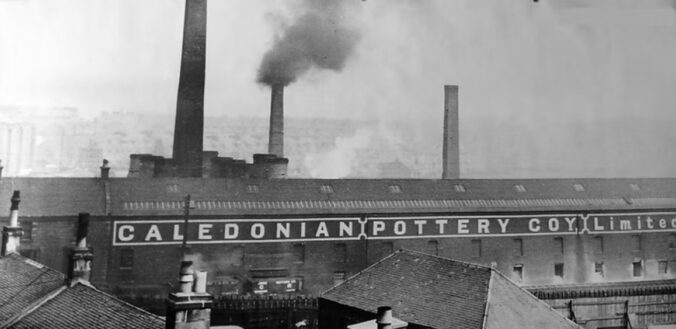
The Caledonian Pottery
This Glasgow pottery was founded as “The Glasgow Pottery” in 1790 by Reid, Paterson & Co on the banks of the Monkland Canal in Garngadhill (modern day Royston, Glasgow), its skilled workforce being drawn from Staffordshire, including the manager, Josiah Rowley. From the outset a very wide range of ware was produced, including porcelain. The newly built canal allowed the economic delivery of coal and clay. The firm was sold to John Aitchison & Co in 1807, who renamed it “The Caledonian Pottery”. In 1810 it was taken over by (or took over, depending on source) the Delftfield Pottery, who transferred operations from their old site to Garngadhill.
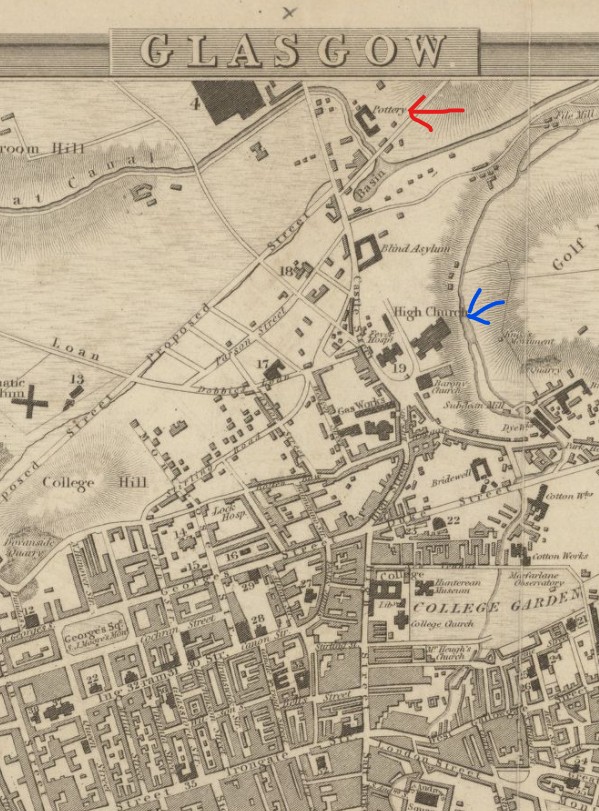
John Dower’s 1830 map of Glasgow shows the Caledonian Pottery (red) north of the Cathedral (blue), on the bank of the Monkland Canal. Source: NLS Maps
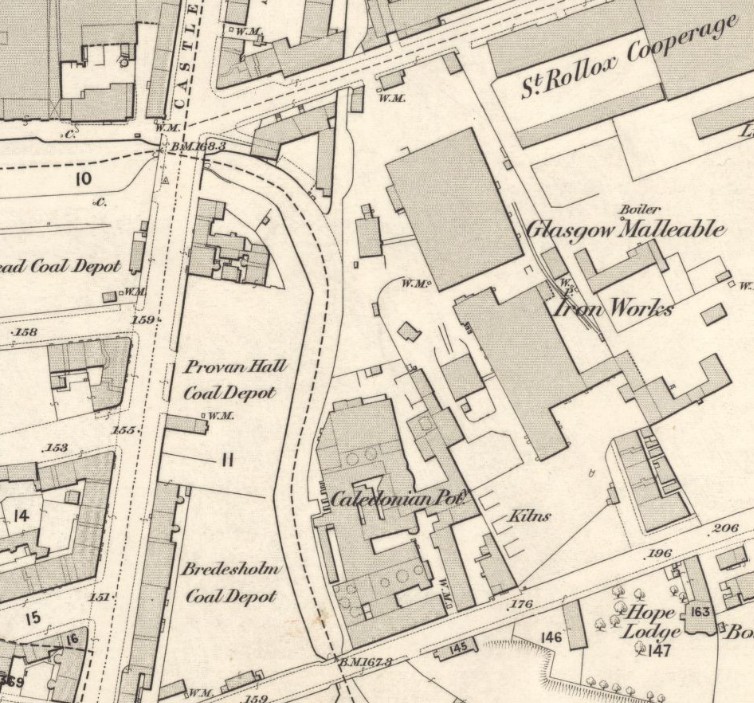
OS Map of 1858 showing the Garngadhill pottery. The huge Tennant’s St Rollox chemical works is developing to the north. Source: NLS Maps
In 1823 Delftfield was dissolved. Kemp & Co took charge for three years but in 1826 the pottery passed into the hands of William Murray Snr, and his son worked for the firm also. Although some sources describe this as a partnership with James Coupar, a leading glass and china merchant in Glasgow, the first mention of Cooper or Coupar in the press was not until 1845. In 1850 Couper left after a disagreement, and set up a glass works close by.
William Murray Snr died that year also, and William Jnr stepped up, along with his brother-in-law, John A Fullarton, forming Murray & Fullarton. They gave up making fine china due to the pollution from the adjacent Iron Works, and took up manufacturing stoneware, for which there was increasing demand for the packaging of food and drink.
William’s son, our William Fullarton Murray, joined the firm and was eventually promoted to be a partner in the business, but after some dispute about share allocation, Fullarton retired. I did discover one curious episode around this period. Murray had been running a factory store, a grocery for employees, with the pottery foreman, Alex Spence. In 1861 the store, including its debts, was passed to John Fullarton Jnr, a young cousin of the pottery partner John A Fullerton. Young John rapidly got into difficulties due to the money owed by workers who had accounts at the store and a downturn in the economy, and he went bankrupt very quickly. The bankruptcy proceedings were recorded in the Herald in unusual detail over a series of reports in July 1861 . John was dead withtin the year, at the age of just 20, from tuberculosis. Whether this was a cause of discontent between partners I do not know.
Frederick Grosvenor joined in 1867, forming Murray & Grosvenor, but left after a year to found his own Eagle Pottery. William Murray Jnr died in 1868 and William took over .
Move to Rutherglen
Around 1870 the adjacent ironworks, seeking to expand, bought out the pottery site and manufacture there ceased (although it turns out the Ironworks leased the intact site to others, notably the Crown Pottery .
Using the funds from the sale, William, now trading as Murray & Co, bought the land of Gooseberry Hall in Rutherglen and built a new larger pottery on the site, conveniently adjacent to the railway line. The pottery became the major employer in Rutherglen. The Burgh’s motto, “Ex fumo fama” (meaning “From smoke, fame”) and the tongue twister “Ru’glen’s wee roon red lums reek briskly” are both probable references to the pottery.
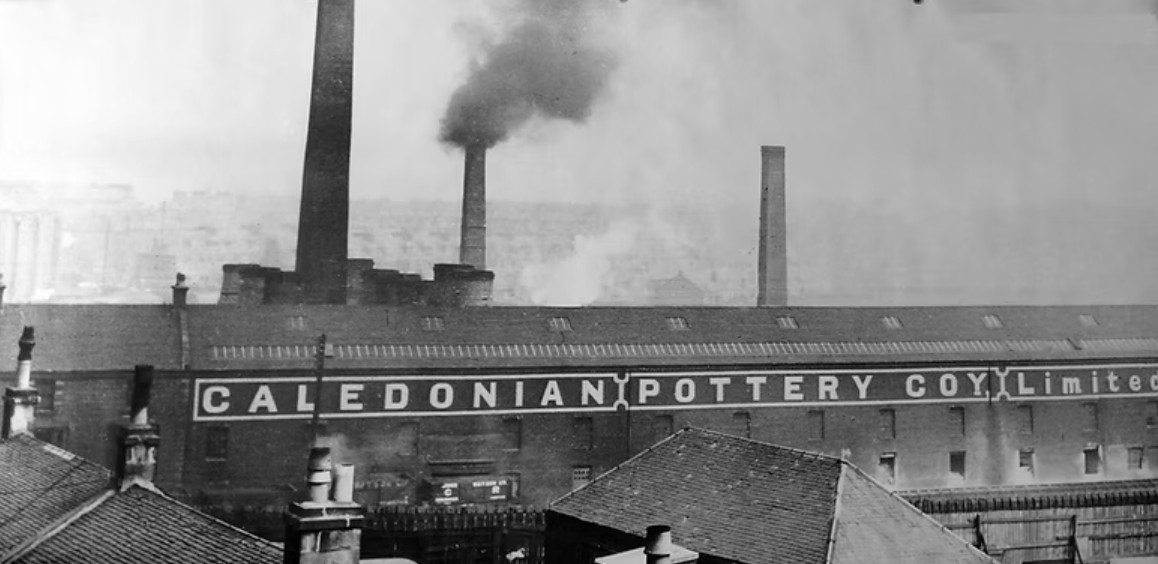
The Caledonian Pottery, Rutherglen around 1912, when in Hartley ownership. Source: South Lanarkshire Museum Service
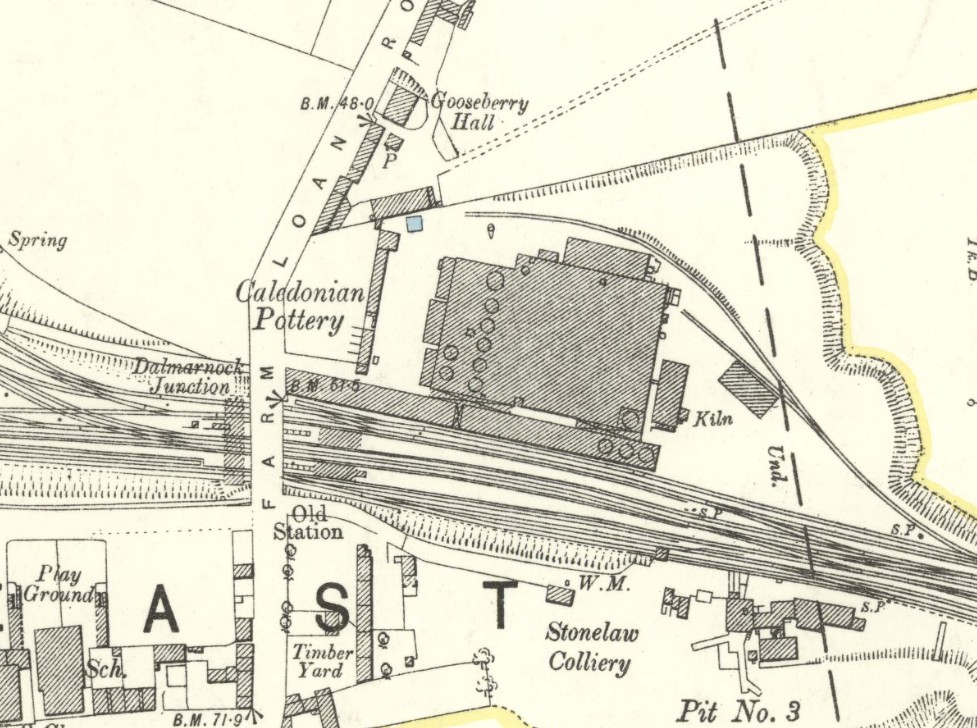
The new Caledonian Pottery in Rutherglen on OS Map of 1892. The rings are the kiln bases. Source: NLS Maps
Apart from the stoneware ginger and beer bottles, cream jars and hot water bottles, one of the most famous products was the Ru’glen Rockingham teapot, which was popular in Britain and extensively exported to the Antipodes. William introduced fireclay into the mix, to enable the teapots to better withstand the heat of the fireplace.
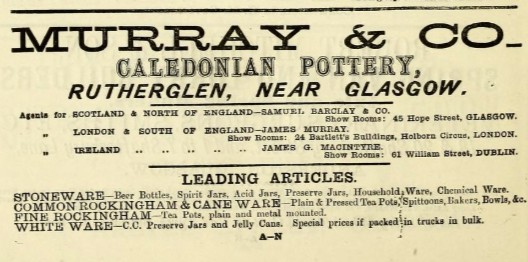
Advert for Murray & Co in Slater’s Directory, 1889
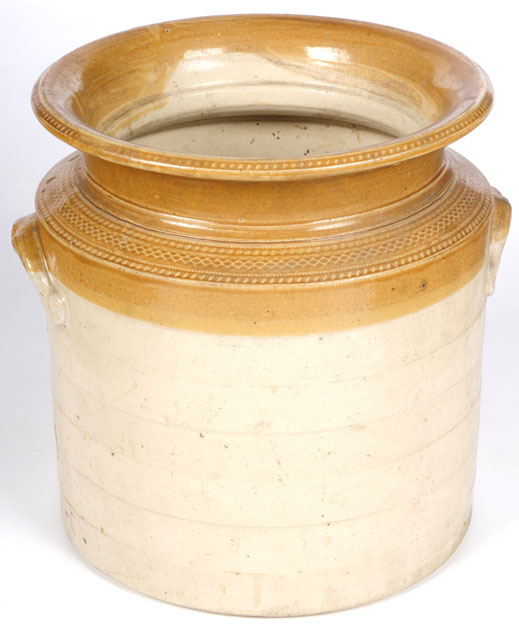
Typical Murray & Co stoneware storage jar. Source:: Glasgow Museums Collection
In 1891 William carried out experiments with new gas-fired kilns, possibly a world-first, and in 1892 founded the Murray & Mackay Patent Gas Kiln Company to exploit it . The idea was to transfer hot gasses from one kiln to the next as each was fired in turn, but it was not entirely successful and caused financial difficulties. The gas kiln company was struck off the register in 1895.
He sought investment from John McIntyre, forming Murray & McIntyre. MacIntyre, the son of a banker, had long been involved in the business. He was a junior partner in the 1860s and the pair had opened a subsidiary pottery in Melling, Liverpool, the Midland Pottery, in 1872. He was also William’s brother-in-law, having married his sister Agnes Murray in 1870 (although Agnes had died after childbirth in 1884). However, despite the investment they continued to struggle, and the business went into voluntary liquidation in 1898. The impending failure may also explain why he retired from Strathbungo to a farm in Ayrshire in 1897. (Note: John was not the pottery’s Irish agent as many sources state; that was his borther James.)
The pottery was then taken over by Hartley’s of Liverpool, the famous jam makers, in order to secure their supply of stoneware jam jars, and continued to make all their products under the Caledonian brand. Hartley’s in Liverpool were already being supplied with stoneware jars from MacIntyre’s Melling pottery, and probably used the Rutherglen pottery to supply their new factory in Birmingham.
As glass jars became more popular, however, business declined and the site finally closed in 1928. In 1930 it was cleared and replaced by the Caledonian Steelworks of A.G. MacFadden & Co. This in turn closed in the 1960s, eventually to be replaced by the M74 motorway.
Pottery Archaeology
The construction of the M74 extension gave archaeologists an opportunity to explore industrial archaeology along its route in 2007-8. This included the site of the Caledonain Pottery in Rutherglen, and the complex of pipes that operated the gas-fired kilns. You can read more about the excavations in David Drew’s book, available online .
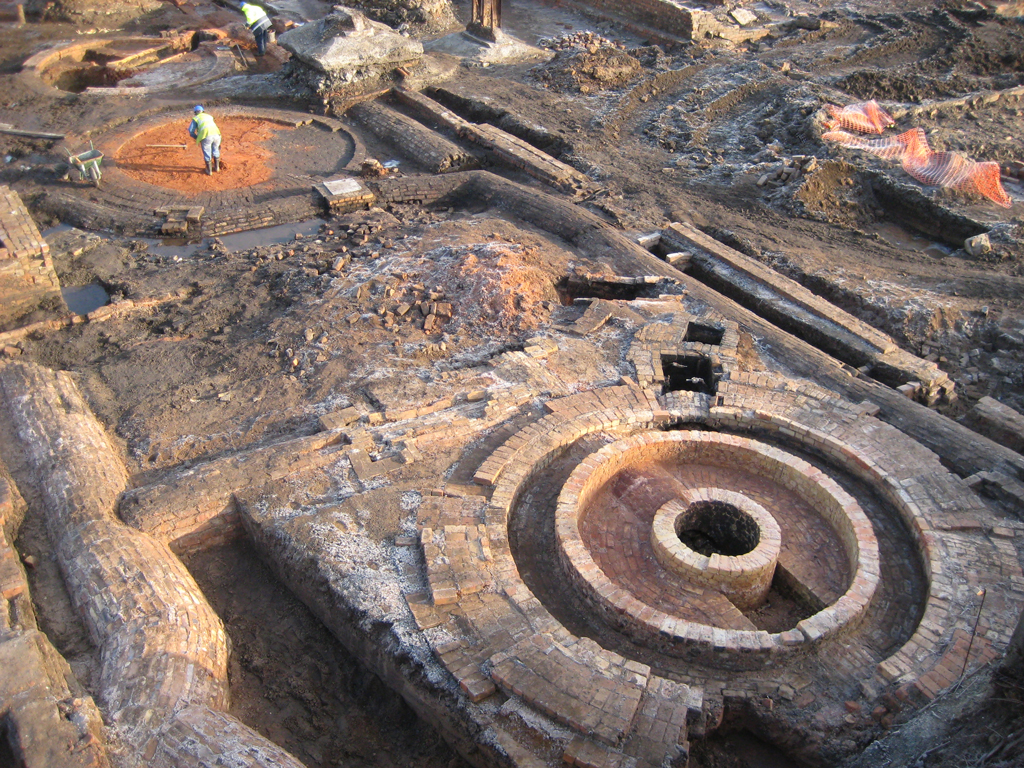
A kiln base at Rutherglen, with brick flues connecting the kilns. Source: Headland Archaeology
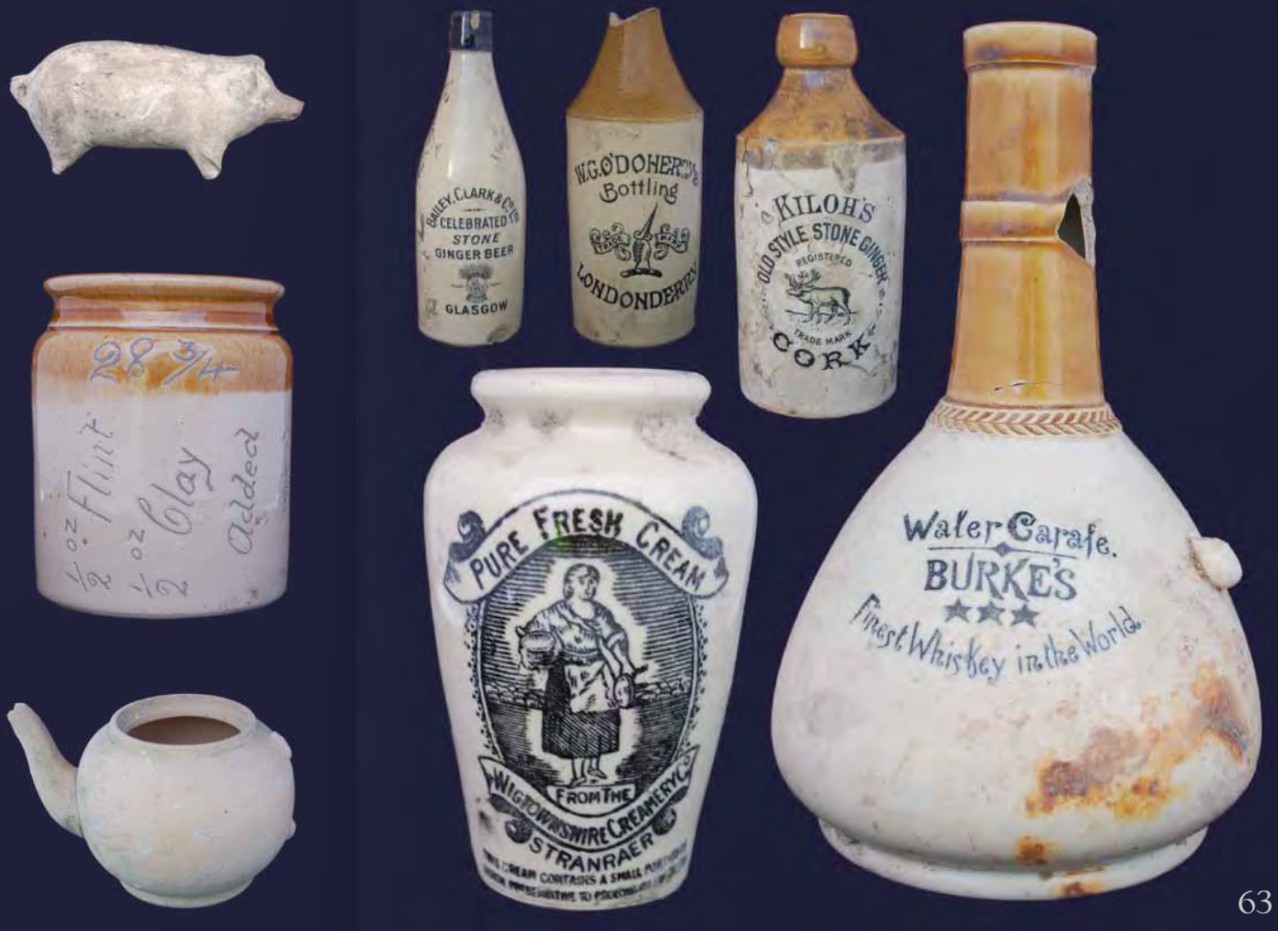
A selection of products from the Caledonian Pottery. Source: David Drew, The Glasgow We Used To Know
John Baillie Hamilton
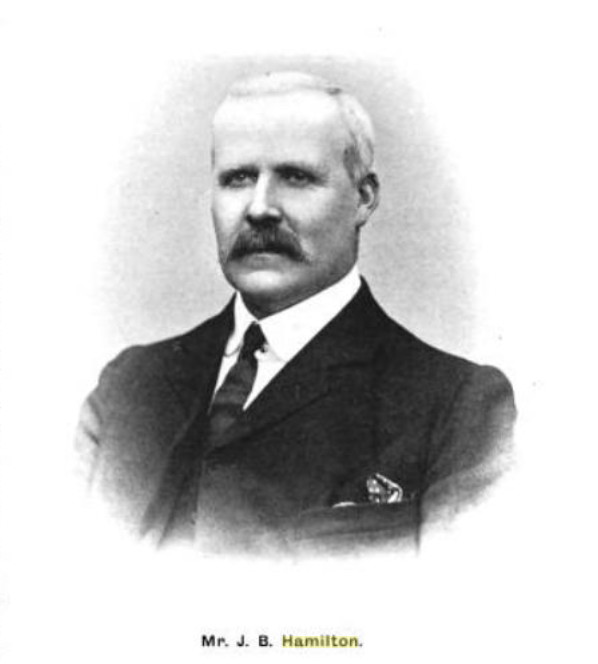
Mr J B Hamilton. Source: Salgueroa, Ancestry.co,.uk
John Baillie Hamilton was born in Bothwell in 1854, the son of James and Jane Hamilton. James was a farmer of 45 acres and a contractor. After attending Hamilton Academy he trained as a vet, graduating from the Veterinary College, Glasgow in 1879. In 1881 he was lodging with an older Scottish vet, David Menzies, in St Austell, Cornwall, but married Mary Steven back in Hamilton in 1883 and was practising there in 1891.
What happened next is not entirely clear, but it seems likely that his veterinary skills were of value to the Glasgow Corporation tramways, which took over Glasgow’s horse-drawn trams in 1894. By 1897 he was the GC Tramways traffic manager and assistant general manager. Perhaps doing his horses a favour, he successfully oversaw the conversion of the network to electric trams from 1898 to 1902, and the construction of Pinkston power station to power them.
He and his family lived at 26 Moray Place from 1897 until 1902, and his last child was born there.
However, in 1902 he moved away from Scotland when he was appointed the general manager of the Leeds tramways . The following year Birmingham tried to poach him, but he declined after Leeds offered him a pay rise. He remained in his post in Leeds for 23 years. He was highly regarded, designed his own Hamilton class trams for Leeds, and was also an advisor to tram networks in other UK cities.
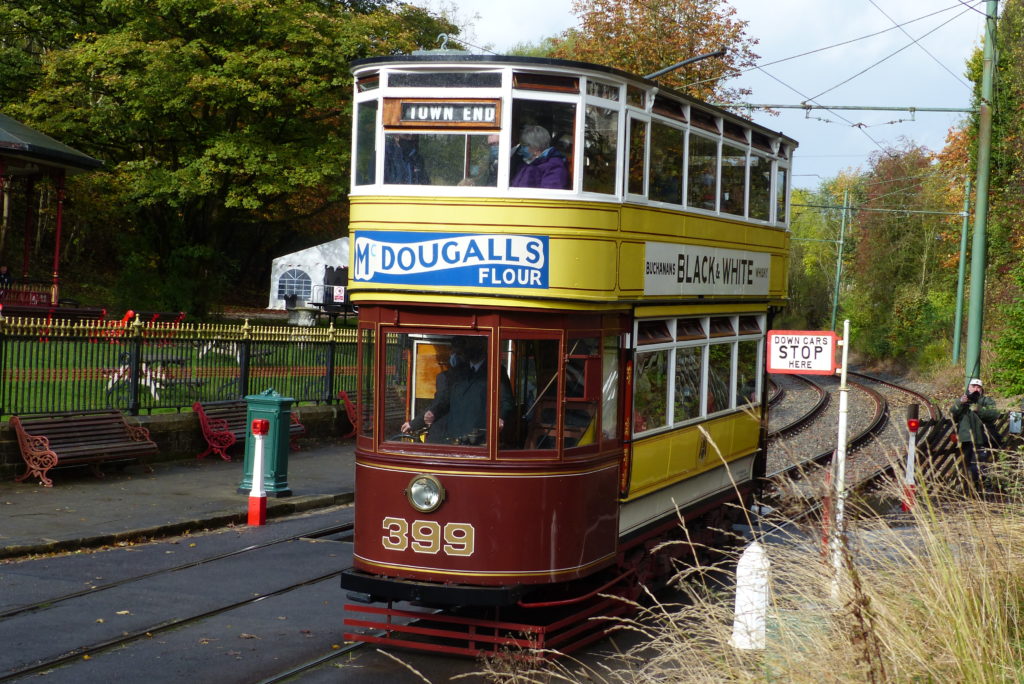
Leeds tram car No 399, a modified Hamilton-designed tram preserved at Crich Tramway Museum. Source: Jim Dignan/Crich Tramway Village
In late 1924 he became unwell and in January 1925 was advised by his doctor to take sick leave and travel to Bath to recuperate. There he had a seizure and died soon after, on 9 January .
William & Jane Newton
The Newtons were resident from around 1902 until 1909.
William Watson Newton’s father was a National School teacher from near Lancaster, who worked in Swansea, Liverpool (where William was born) and then for many years in Caernarfon, where William grew up. At 16 William was working with his father as a bookseller and stationer in Caernarfon.
The firm of Newton, Robertson & Co was a Scottish slate merchant based in St Enoch Square and formed around 1878, with William, still in Caernarfon, as a partner. It seems likely they were trading in Welsh slate. He got married there in Caernafon to Jane Moss Whitehouse Rowland. Their first child was born in Caernarfon in 1880 but by the following year they had moved to Hillhead in the Burgh of Partick.
By 1887 they had moved to Strathbungo, purchasing 16 Moray Place. There they stayed, and the last of their children were born, until around 1902 when they rented out the house, and purchased 26 Moray Place as well.
James Robertson, their partner, died in 1891 and the business was continued under the same name by William and his mother Margaret back in Caernarfon . The business continued up until 1972 when it was bought out, and through further mergers has disappeared under the Travis Perkins banner.
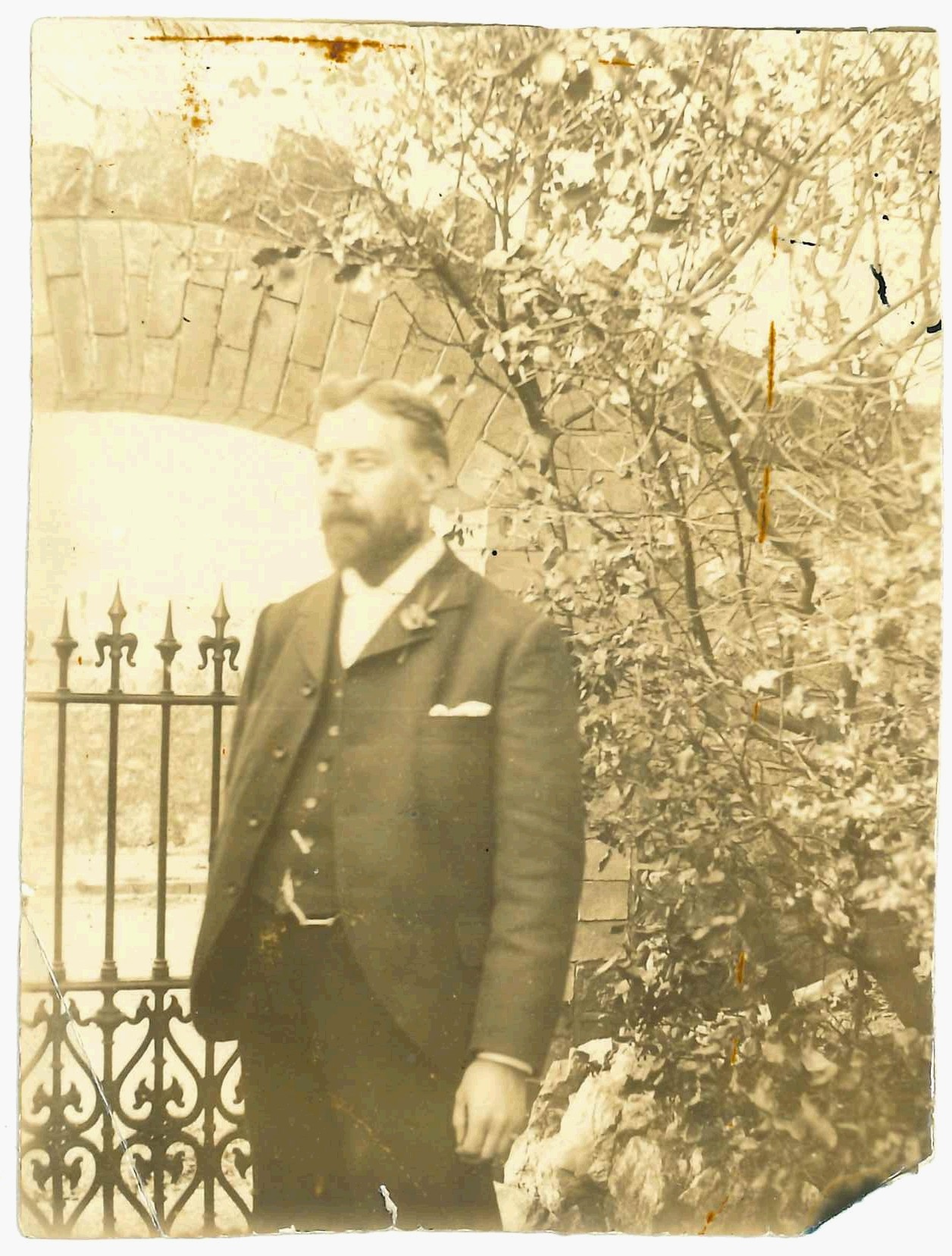
William Watson Newton at the family home, Sunnycliffe, Caernarfon, 1900. Source: Hertfordshire Archives CJ40/2/21/1
William didn’t forget his Welsh roots, contributing to a fund to allow the Penrhyn-Dinorwic Male Voice Choir (Côr y Penrhyn), made up of Welsh slate quarriers, to attend the first international Eisteddfod at the Chicago World Fair in 1893 .
William died while visiting Harrogate in 1906, and his wife Jane died at Moray Place in April 1909.
John Campbell Douglas
Next up was John Campbell Douglas. With a name like that, he should be easy to track down in Glasgow, right?
Wrong. He was the fifth of eight children of Robert Douglas of Southwick, Kirkudbright and Margaret Newberry of Axminster in Devon. The first six children, including John, were all born in Bridport in Dorset, but how and why Robert ended up in southern England isn’t clear. The seventh child was born in Govan, and the eighth in Kilmaronock, Dumbartonshire, (not Kilmarnock, note!) where Robert was farming 177 acres by 1861.
Yet by 1871 Robert was a wine merchant in Glasgow, and two of his boys, including our man John Campbell Douglas, were working as engine fitters. While he can’t be found in the 1881 census, a few weeks later he was down in Walthamstow, East London, marrying local girl Florence Robinson. Their first child was born in East Ham, London, two more in Glasgow, the next in Lewisham, and the last four in Broughty Ferry. Quite a mobile family for the time. The 1891 census recorded him as an inspector for an engine & boiler insurance company. In 1894, his wife Florence died of pneumonia.
By 1891 John was back in Glasgow, at Forth Street in Pollokshields, and like his father had switched career to became a spirit dealer. His work address in the PO Directories was 1 Ritchie Street, now the Sher warehouse under the M74 off Kilbirnie Street. Old maps show a very different neighbourhood then, with a building on the corner, small industry and some tenements, but no record of a pub. Old Glasgow Pubs has a John C Douglas as the licensee of the Gael Vaults on Clyde Street 1903-09, but it closed thereafter .
In 1907, he remarried, to Alice Robinson, his first wife’s sister. They moved to 26 Moray Place in 1909, and were there in the 1911 census with two of his boys, William, an assistant dentist, and Charles, a colliery clerk. John died at Moray Place, by that time renumbered as 57 Princes Square, in 1932 (it was renamed Marywood Square months later). At the time his son Charles was living nearby at 35 Princes (Marywood) Square, and No 57 was let out while Alice moved to No 43, where she appeared to be running a boarding house on behalf of a Mary McEwan. She died in 1944.
And that’s all I know of No 57 Marywood Square. Additions and corrections are always welcome.
Leave a Reply