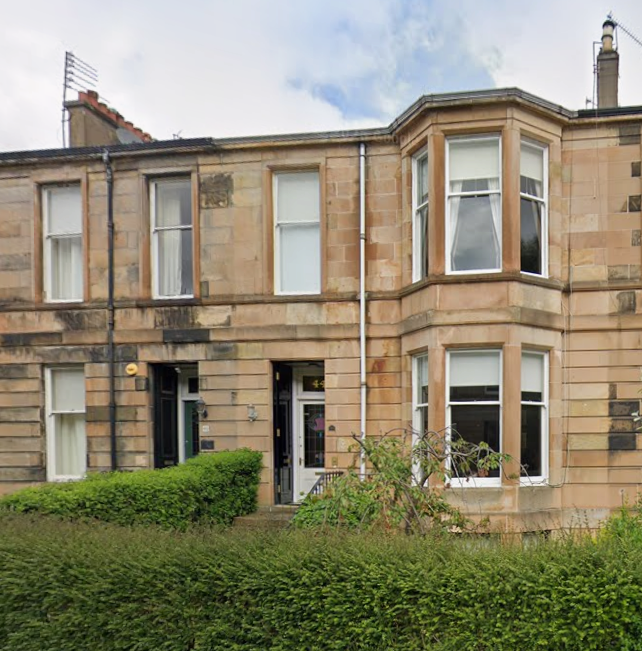
Some time ago I came into possession of the old deeds for 24 Marywood Square, formerly known as 11 Princes Square. They told us the builder of the terrace on the north side of the street was one Robert Weir. They also suggested the builder fell on hard times, but I knew nothing more.
With a little detective work I have uncovered more of the story, and it is not a happy one.
William Weir
William Weir was born in the parish of Cathcart in 1810, and married Agnes Biggar in Bridgeton in 1832. He became a builder, and is recorded to have erected tenements in Upper Crown Street in 1858, Naburn Street in 1862, and in Pollok & Ardgowan Streets in Kinning Park in 1868. The latter, well-known for the gardens of Pollok Street, were destroyed by the M8.

Pollok Street, Kinning Park, with gardens. Credit: ProjectGlasgow, Facebook
His eldest son William Weir Junior, married in 1860 and moved to Belfast where he worked in cotton spinning.
Robert Weir
His second son was our Robert Weir, who joined him in the building trade. Although he was undoubtedly supported by his father, he was the driving force behind the Princes Square project – it is his name on the financing and feuing documents. By this time they lived at and ran their business from 1-10 Allanton Terrace, a building on Langside Road at the junction of Allison Street.
Princes Square
The Princes Square terrace was built 1877-78. Robert was 33 years old and first appeared as a joiner in his own right in the PO Directories in 1877, so this may have been his first major building project.
The houses were advertised for sale in the North British Daily Mail on 20 November 1877, possibly while under construction:
To SELL or LET, Superior Self-contained HOUSES of 5 Rooms, Kitchen, and Laundry, situated about 3 minutes’ walk from new Railway Station, Strathbungo. For further particulars, apply to Robert Weir, 1 Allanton Terrace, Crosshill; or at the Houses.
Further adverts appeared in 1879. However it appears that only five houses had been sold by 1885, the rest being let. Times were difficult following the collapse of the City of Glasgow Bank in 1878, and it seems the project was proving a financial drain.

Glasgow Herald,1 Sep 1879. Credit: BNA
Tragedy ensues
On 30th August 1880, William left Robert in the sitting room at Allanton Terrace for a few minutes, but on his return found his son lying with a deep gash in his throat. Despite the attentions of local doctors Robert perished on the floor.
Robert’s death certificate noted that he
had suffered for some weeks from embarrassed circumstances and melancholia, and cut his throat on the 30th August 1880, as cert. by Peter Stewart, MD.
“Embarrassed circumstances” is Victorian speak for poverty or financial ruin, but it is hard to imagine the pressure that would have driven him to such an act. The death was registered by Lewis Black, his brother-in-law, who rented one of his houses at 7 Princes Square (now 16 Marywood Square).

Govanhill: A case of Suicide. Rutherglen Reformer, 4 Sep 1880. Source: BNA
The ownership of nineteen houses in Marywood Square, along with the associated debts, passed back to William, his father. William died in 1890, aged 80, and so ownership appeared to pass to his eldest son William, in Belfast, and his son-in-law the aforementioned Lewis Stuart Black, a commission agent who had married his daughter Agnes. While the Scottish law was beginning to change in the 1880s, this appears to reflect the inability of women such as Agnes to retain possession of their own inheritance upon marriage at that time. However, not only did a man inherit her wealth, he also inherited her debts.
The debt
The deeds for 24 Marywood Square spell out the consequences. In 1877 Robert had taken a £1000 loan from the trustees of one Walter Fairlie, a recently deceased farmer in Balfron, Stirlingshire, to fund the construction of the house. Presumably similar arrangements were made with other investors for the other properties, although the details for the other houses are not known.
Walter had married Mary Stewart, 36 years his junior, in 1855, and began a family at 58. His wife gave him six daughters, but died from complications of childbirth in 1867, aged only 33. Walter died in 1874, but had entrusted four local male friends to manage his estate on behalf of his five surviving young orphaned daughters, Mary, Agnes, Christina, Elizabeth and Margaret Stewart Fairlie. One of their investments was in Robert’s building project.
By 1896 Mary had married Thomas Hart, a saddler, Agnes had married William McKeich and had a child Mary, before dying at 30, and Christina and Elizabeth lived together unmarried. Margaret had died as a child. That year they demanded their £1000 back from Lewis Black and William Weir Jnr, and the £193 12s 7d in interest. I presume the debt was not repaid, and so, as their contract permitted, they came to repossess the property instead. In the same way they also acquired 12 Princes Square (26 Marywood Square) next door. Elizabeth died soon after, and it was Mary Hart, Christina Fairlie and their young neice Mary McKeich who took the spoils.
They sold both houses in 1902 following an advert in the Glasgow Herald, thus recovering their investment after 25 years.

Proof of advert to be placed in Glasgow Herald, February 1902. George Outram was the owner & publisher of the Herald. Credit: Author’s own
The subsequent owners and tenants can be found in the database.
Additions and corrections welcome.


Recent Comments