
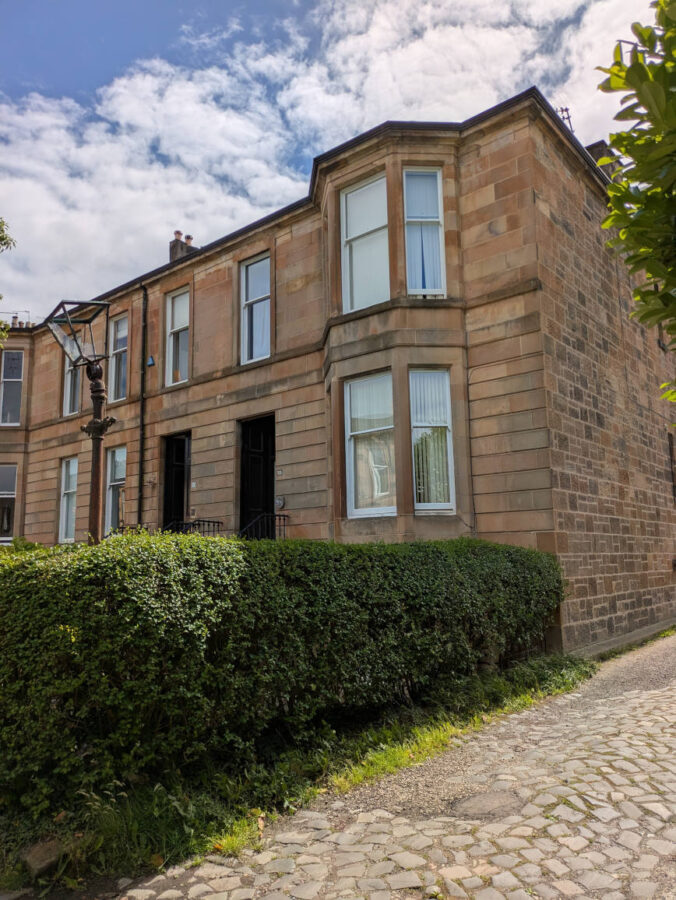
The story of 55 Marywood Square, formerly 25 Princes Square, and its previous occupants.
James Robertson
The long terrace on the south side of Marywood Square was built c.1884-5 and in the 1885 valuation roll the entire terrace was listed as belonging to James Robertson, a mason and builder living in Pollokshields. He first advertised the houses for sale or let in the spring/summer of 1884. Yet in 1891 he went bankrupt, he died in 1893, and by 1895 the valuation roll notes the entire terrace was back in the ownership of William Stevenson, the quarrymaster and original developer of Strathbungo.
Ownership
William Stevenson passed 25 Princes Square on to his youngest daughter, Elizabeth, who also inherited Nos 26 & 27 (now 53 and 51 Marywood Square). She sold the house some time after 1915.
Elizabeth married the architect James Laird and they had a daughter Dorothy. She died in 1945. Her daughter was quite a character, taking a passage on a Finnish sailing ship, the Penang, but ending up becoming an able seaman and sailing round the world with her. She wrote many articles and books, including the first biographies of Queen Elizabeth II and of the Queen Mother, and as a correspondent for The Herald, Scottish Field and the horse racing papers. Her Herald obituary in 2000 described her mother Elizabeth as a disabled painter .
Robert Murdoch
Robert McDonald Murdoch was the first tenant in the property, from 1885 to 1890. He was himself a mason and builder.
He was born in Glasgow in 1844, the fourth of ten boys of Thomas Murdoch and Mary Lang. The couple had two daughters also. Thomas was a monumental sculptor, a partner in the firm of Connell & Murdoch in the Gorbals. After the firm closed, Murdoch continued in business as a mason and builder as T Murdoch & Son until his death in 1865, and thereafter the business was managed by his son Robert, who in 1871 renamed the firm as R Murdoch, Masons and Builders, at Clyde Terrace.
Robert married Agnes Hendry Robertson in 1865, and they had six daughters, before a single son. In 1881 he was living in the Gorbals and employing 40 men and 3 boys. By the time Robert moved to Strathbungo his works was at 10 King Street (now Shawbridge Street) in Pollokshaws, although he later moved it back to Commerce Street in Tradeston. The family downsized to a tenement flat at 33 Nithsdale Road by 1891, but subsequently bought a villa in Pollokshields, “Hauseville” at 187 Nithsdale Road, where they remained until her death in 1920 and his in 1923. Their son Thomas appears to have continued the business until his death in 1943, when it was sold; it continued to trade as R Murdoch until 1955 .
Robert was Deacon of the Incorporation of Masons in Glasgow in 1884, as was his son Thomas in 1922. He was politically active, sitting on Gorbals Parochial Board between the 1870s and the 1890s, and was vice chairman of Tradeston Liberal Association in 1886 .
Despite the glowing description below, taken from the wonderfully over-the-top Stratten’s trade directory of 1891 , I can find little detail of Robert’s work. The only building I can reliably attribute to him is the former police and fire station on Craigie Street, built in 1895 for Glasgow Corporation .
ROBERT MURDOCH, Mason and Builder, 19-21, Commerce Street, S.S., Glasgow.
Those who visit Glasgow for the first time will acknowledge that the most striking impression they experience is the sense of grandeur in the proportions of the buildings of the city, and the numerous features of architectural and structural excellence which her many noble thoroughfares present ; heightened by the liberal employment of stone as the material for construction. Another important factor in the attainment of this gratifying result is that the city holds an indisputably larger proportion of first-class building firms capable of the construction of buildings of magnitude than any community of its class in the kingdom, amongst whom we single out, as illustrative of our subject, Mr. Robert Murdoch, Mason and Builder, Commerce Street, as thoroughly representative of this important branch of industrial art.
The business conducted by this gentleman is of old and substantial standing, having been established by him in 1863, and during this extended period has been greatly developed and increased to its present successful proportions. The premises occupied by Mr. Murdoch comprise well-appointed suite of offices and extensive stores in Commerce Street and spacious builder’s yard in Canal Street. The latter is of commodious dimensions, and conveniently arranged for the operatic departments, being directly connected with the railway, a siding enabling the Company to place the heavy materials, stone, bricks, etc., required in the business at once on the ground. Extensive masons’ sheds are provided in the works for the convenience of the numerous workmen engaged in preparing stone work for use in the construction of the buildings in course of erection by the proprietor in all parts of the city, and an immense stock of every description of material is kept in hand for this purpose. A staff of experienced workmen, varying in number, according to the contracts in hand, from 100 to 250, is employed in the business, which is admirably conducted under the personal direction of the principal, whose thoroughly practical knowledge of every detail of the trade supplies an ample guarantee for perfection of order, system, and regularity in the management department.
It would be impossible, within the limits of our space, to attempt to enumerate the many notable architectural features in the city and surrounding districts which owe much of their excellence of construction to Mr. Murdoch’s ability and skill, and it must suffice to mention that this gentleman’s long connection with the trade has been associated with the erection of many of the principal public and private buildings in the locality. In conclusion, we may add that Mr. Murdoch is widely known in the district, and takes a very active interest in all matters affecting the well-being of the community, and as an honoured manager of the Govan Parochial Board, and Chairman of the Lunacy Board for that District, he has done good service to his fellow-citizens, and has gained a well-deserved eminence in the estimation of all classes of the ratepayers.
Robert More Jnr
The next occupant, first a tenant of James Robertson, then of William Stevenson, was Robert More Jnr. Robert was the son of Robert More Snr and Helen Couslin, and was born in Hamilton around 1850, the sixth of eleven children. His father was both a lace maker and a fruit merchant in Glasgow, who contined in business despite a brush with bankruptcy in 1862. Robert lived with his father well into his thirties, in Glasgow and in Covington, Lanarkshire. He worked initially as a clerk and warehouseman’s cashier.
In 1890 he moved to 25 Princes Square with three of his sisters, Isabella, Jessie and Margaret, and their 19 year old servant Catherine McLellan. That year he became a partner in the business where he worked, the well-established firm of Simpson, Hunter & Young, silk mercers and warehousemen of 57-61 Buchanan Street . He married late, in 1895 in Leith to Jessie Barlow, 17 years his junior. She was the daughter of a Wesleyan Minister, and born on the Isle of Man, but resident in Leith; her grandfather had been Provost of Leith. Soon after they left Strathbungo and moved to West Fulton Cottage, Kilbarchan. Jessie gave him one son, another Robert, in 1899. Robert died in 1915.
Simpson, Hunter & Young
Simpson, Hunter & Young was a Glasgow department store founded by Thomas Simpson, Andrew Hunter and Alexander Young, which opened on 6 September 1854 at 59 Buchanan Street, Glasgow. The three partners had worked previously for Messrs. Campbell & Co. Their advertisement in the Glasgow Herald two days before they opened stated that there would be ‘a New and Complete Stock of SILK MERCERY, FANCY, and GENERAL DRAPERY GOODS, selected personally by the Partners in the various Manufacturing Districts in England and France’. The stock included a variety of different fabrics, accessories and mantles. By the late 1860s the firm also had a dressmaking department. In 1890 the firm expanded either side to 57-61 Buchanan Street.
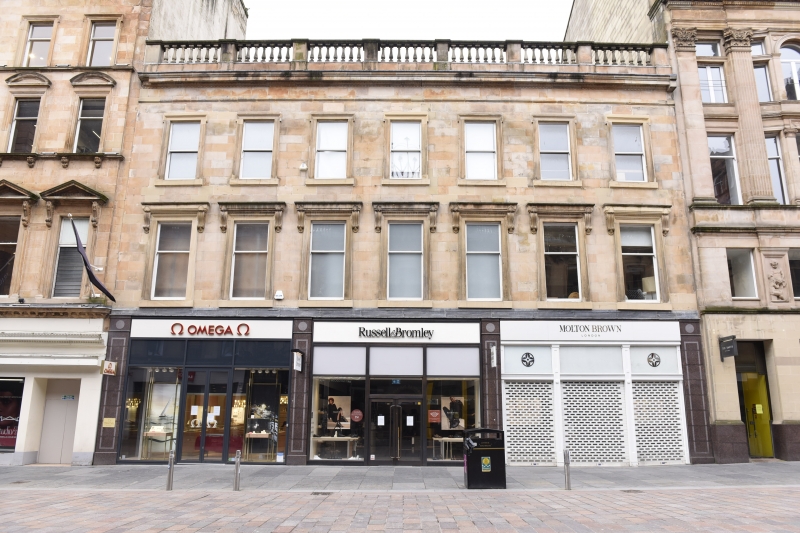
Former premises of Simpson, Hunter & Young, built c 1840s. currently numberd 55-59 Buchanan Street. Source: British Listed Buildings
In the 1890s their designs were being sold by American department stores, including Jordan, Marsh & Co., Boston, and Marshall Field and Company, Chicago. By 1913 the company had expanded again into 55 Buchanan Street. After the death of Andrew Hunter, sole surviving partner, in 1932, it was acquired by his widow, Mrs Margaret Hunter, who sold it on .
Glasgow Museums has some of their dresses in its collection, including this 1895 dress in purple silk velvet and leg-of-mutton sleeves .
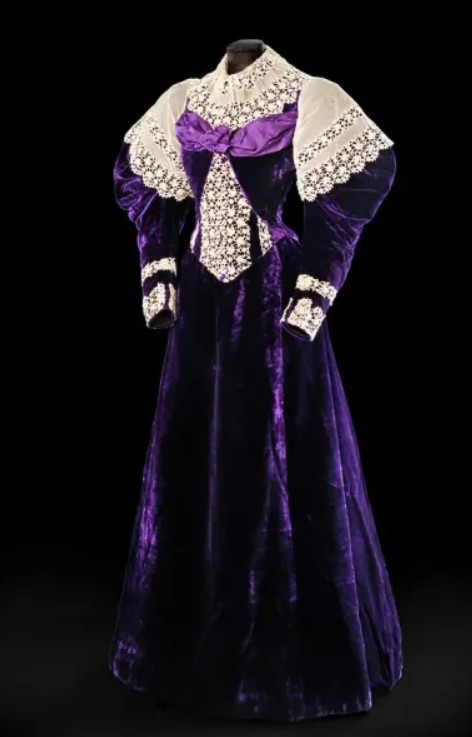
Simspon, Hunter & Young dress in the Glasgow Museums collection. Source: Glasgow Museums
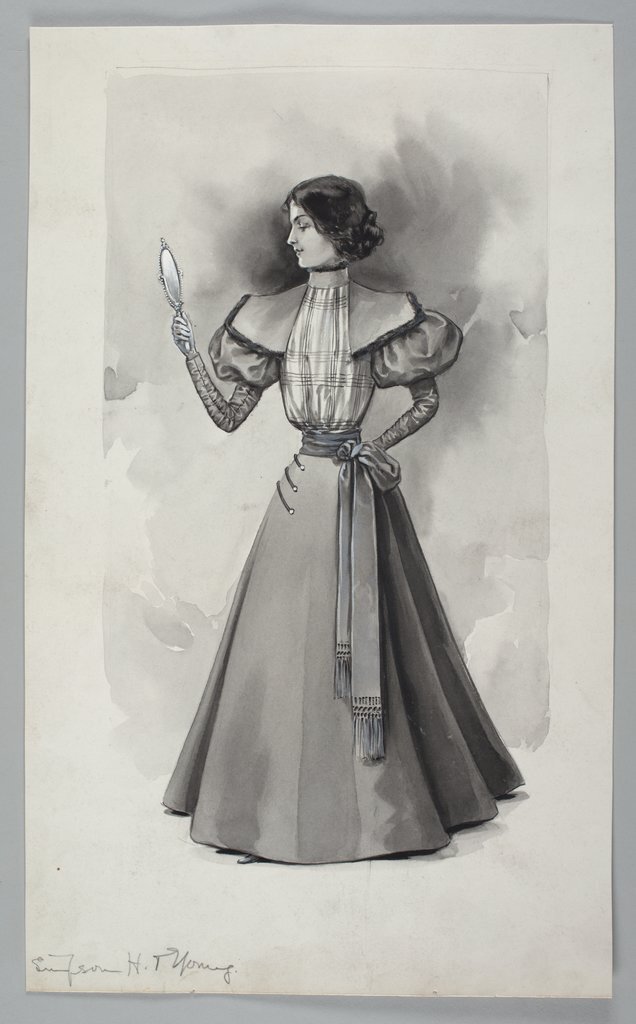
Watercolor fashion illustration of a dress for Simpson, Hunter & Young, Glasgow, Scotland, 1896-1897. Source: Chicago History Museum
Charles Stevenson
Charles Stevenson rented the house from 1897 until 1915, but due to complex and utterly tragic family circumstances was quite hard to pin down. He was a wholesale warehouseman, his company Stevenson & Co being based at 37 Queen Street. His business is not well documented but an advert in the Herald for “experienced miliners” suggests he was in the clothing or accessories business.
His father John Stevenson was a soap and candle maker. He married Elizabeth Stewart in 1841 and they had six children. He bought a factory in New Sneddon Street in Paisley (The Snowdown Soap Works) and the family lived in the same street. However one morning in 1874 John was found dead in the White Cart, which ran behind his factory. It was supposed he must have “mistaken his way, and fallen in the river” on his way home the night before. He was 53. He is added to a significant list of individuals in these pages who have drowned. Drowning was much more common in Victorian times, probably a combination of lack of swimming ability, unprotected waterways, and drink.
John’s first son, also John, took over the business. He had married Maggie Cameron and had a daughter Elizabeth but within a year of losing his father, John lost his wife too. Three years later John himself died of an acute attack of pneumonia, leaving Elizabeth an orphan at the age of 10. The company reverted to his mother, and though it was put up for sale in 1885 when she retired, it appears to have passed to her second son, Robert.
Robert was a candle maker, and later a travelling salesman, presumably for the company. He married Mary Ann Hamilton in 1875 and had four children, John, Robert, Charles & Jane. Having presumably taken over on his mother’s retiral in 1885, in 1886 he died of opium poisoning. Tincture of opium was freely available without prescription, and the only effective painkiller at the time; overdoses were not uncommon. While I can’t trace Mary Ann’s fate, I presume she also died young.
Their eldest son joined the Empress training ship on the Clyde, an institution for delinquent or orphaned children, which trained him for a life at sea. He rose to be second mate but in 1900 was swept overboard from the SS Buckingham somewhere off Taipei and drowned. The second son Robert died as an infant. I presume the other two, Charles and Jane, were left orphaned.
Our Charles Stevenson, the warehouseman and the third son of John senior, appears never to have married. In the 1891 census he was living, possibly lodging, with another family at 8 Glencairn Drive in Pollokshields. With him were his mother Elizabeth, his orphaned niece Elizabeth, and his orphaned nephew and niece, Charles and Jane. They all then moved to 25 Princes Square in 1897, where his mother Elizabeth died the following year.
All this tale of woe and death leads us up to the 1901 census (which was the starting point of this puzzle), which recorded the occupants in Strathbungo as Lizzie, Charles and Jane Stevenson. These are the three orphans, who have evidently ended up in Charles’ care, although there was no sign of Charles himself on census night. I eventually found him staying at the Holborn Viaduct Hotel in London, presumably there on business.
Charles died at 25 Princes Square in 1914. Tragedy continued however. Elizabeth married in 1901 but had died in 1910. Young Charles, outlived his uncle by only a year, dying in 1915. Jane married a Mr Lamberton in 1915 but her subsequent fate is unknown; hopefully she fared better.
Allan S Jenkins
Allan Stewart Jenkins was born in Anderston in 1872 to Thomas Jenkins, a provision merchant, and Marion Stewart, one of 12 children. He married Catherine Cooper Muir and had three children, Thomas, Frances and Marion.
They lived in Glencairn Avenue, then at 27 Fotheringay Road. They were only briefly resident at 25 Princes Square around 1915-18, and they soon moved to 16 Glencairn Drive, where he remained to his death in 1972 aged 99.
He was a flesher, or butcher, and in 1915 was recorded in the Post Office Directory as working at 72 Nithsdale Road. This shop, currently Lunar Cocktails, opened in 1877 as William Bennie & Sons, butchers, and the Bennie sign still adorns the building to this day. Bennie remained there until 1915, so Allan Jenkins either worked for him, or succeeded him.
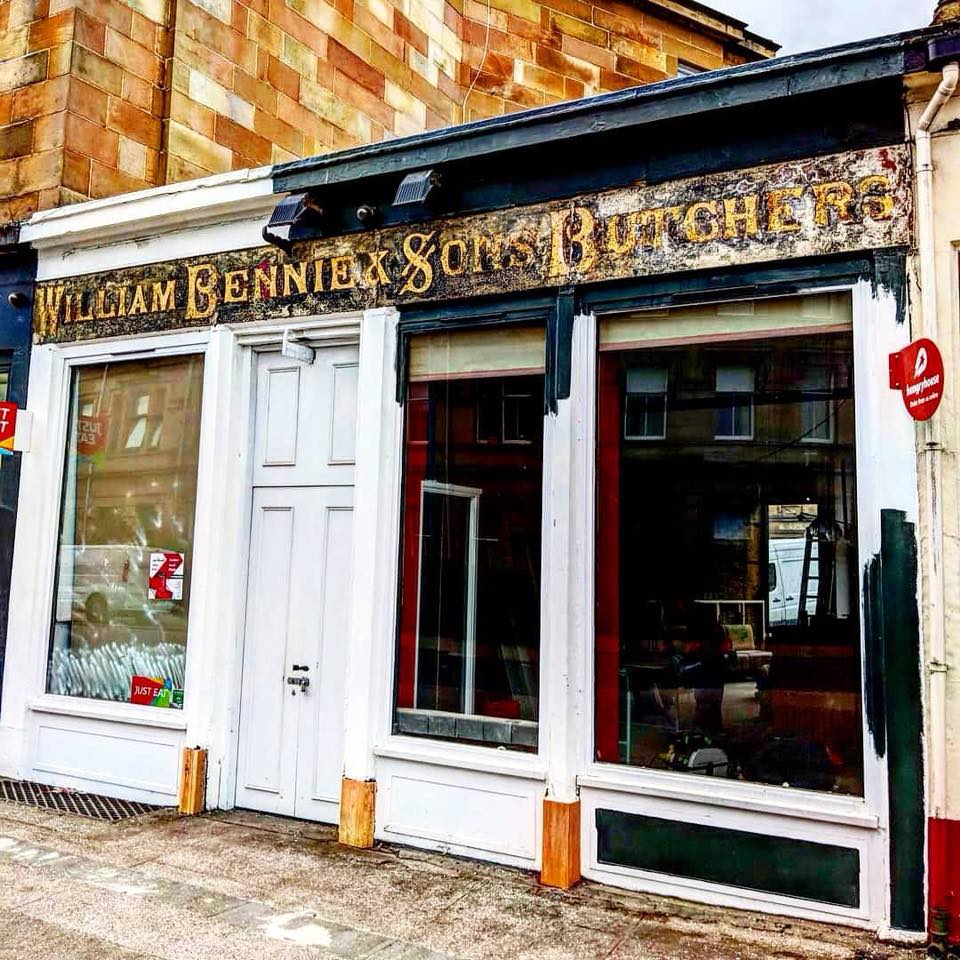
Allan’s workplace in 1915. The William Bennie sign was unveiled during renovation, July 2018
Allan also had a shop at this time at 207 Albert Road in Pollokshields, and this appeared to be his main business thereafter in the Valuation Roll, although in the PO Directories the shop was trading under the name Train Brothers.
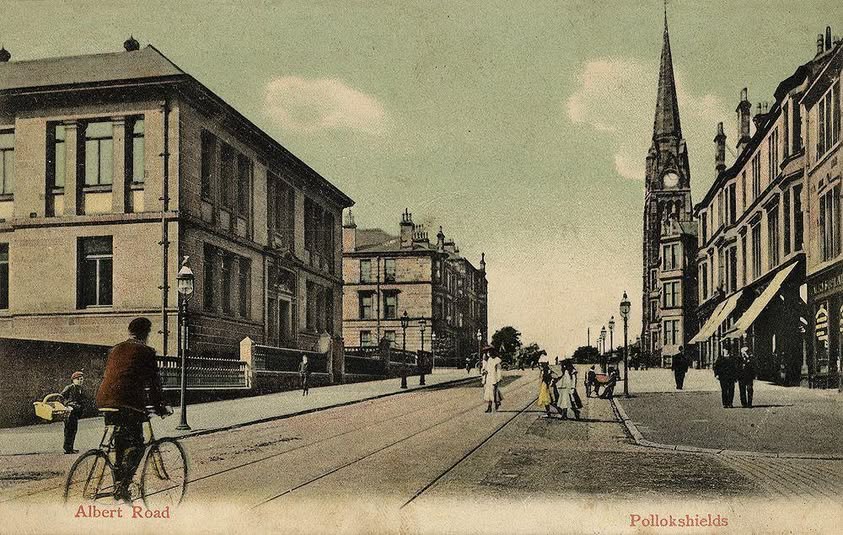
Albert Road (now Drive) in Pollokshields, 1917. Allan’s shop was just behind the photographer’s left shoulder. Source: Glasgow City Archives TD1586/6
Neither of his daughters ever married, and they lived with him at Glencairn Drive. This perhaps reflected the lack of eligible young men immediately following the Great War.
His son Thomas attended the High School of Glasgow, then intended to follow his father as a butcher. However when the war broke out he signed up with the 7th Batallion of the Cameronian Scottish Rifles, the successors to Strathbungo’s 3rd Lanarkshire Rifle Volunteers on Coplaw Street. They landed at Gallipoli on 18th June, and he went into action on the 28th, and disappeared. He is recalled in the Glasgow Roll of Honour, which notes his residence as 25 Princes Square (the address when he enlisted, perhaps), though other records state his parents were from Glencairn Drive.
Oddly, another soldier is recorded on the Strathbungo Roll of Honour at 25 Princes Square, one Lt John Muir Martin. He was Thomas’ cousin, through their mothers, Catherine and Frances Muir. His father William was headmaster of Strathbungo Public School (now St Brides), but he lived with his aunt at 25 Princes Square . John started as an apprentice civil engineer for the Caledonian Railway Company but enlisted in 1915. He was also in the 7th Cameronians, but was killed on 6 Nov 1918 trying to capture a German position at Berlaimont, just 5 days before the armistice.
William & Marion Purdie
William Purdie, a teacher, married Marion Bryan in Gibson Street, Hillhead in 1892, but they appear not to have had children. They moved from 3 St Andrews Drive to 25 Princes Square around 1919, and were the first owner-occupiers, presumably purchasing from Elizabeth Stevenson or Laird. However, he died there shortly after moving in, on 22 Dec 1919, and she moved away to Maryhill around 1921-22.
James & Jeanie Mathieson
James Cameron Mathieson, a commission agent in Glasgow, married Jeanie Graham Dow in 1894. The couple had two children. They probably moved from 6 Dalziel Drive in Pollokshields to 25 Princes Square on James’ retirement, around 1922. However, in May 1922 he too died shortly after moving in, of TB. Their daughter married in 1925, leaving Jeanie there alone, and she moved at some point to Leven Street. She was listed as the owner in the 1925 Valuation Roll. She survived until 1966.
In 1930-31 the Valuation Roll and Electoral Register state the owner as Mary J Stevenson, who I have not otherwise identified.
Bessie Miller
Bessie Henderson married James Younger Millar, a metal merchant, in 1914 in Strathbungo Parish Church. Rev McMillan, another Strathbungo resident, officiated. However they then moved to Bearsden and had a daughter Helen. James died in 1928 and at sometime around 1931 Bessie purchased 25 Princes Square, soon to become 55 Marywood Square, and ran it as a boarding house. The Electoral register notes some regular boarders such as Elizabeth Walker and Margaret Waugh. In 1939 William Lambie, a consulting combustion engineer, was also living there.
Bessie’s daughter lived with her even after her marriage in 1939, and had a son there in July 1942. Her husband was John Minto Lloyd, a merchant seaman. He was Second Officer on the motor tanker Athelprincess, which was straggling behind convoy UC-1 when it was struck by two torpedoes fired by the German U boat U-552 on 23 Feb 1943. The vessel sank west of Madeira. One crew member died, but the other 50 were picked up by HMS Weston, and eventually landed in Puerto Rico. The same day HMS Totland took revenge by catching and depth charging U-552, which was lost with all hands. John Lloyd received a commendation for bravery in November as a result of this incident.
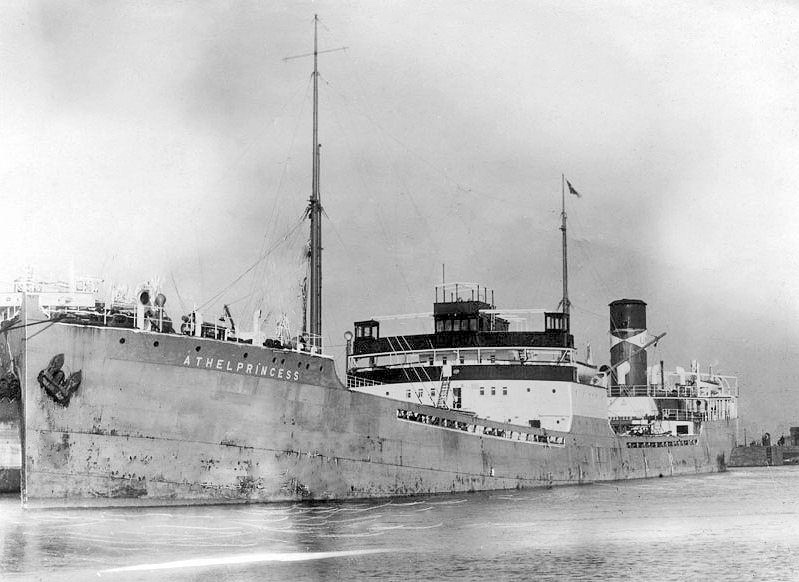
The Athelprincess, a bulk carrier for the Athel Line / United Molasses Co Ltd. Source: Clyde Ships
and the rest
By November 1944 a Mr Goldschmitt of 55 Marywood Square was advertising for an apartment in Cheltenham in the Gloucesterhire Echo.
In June 1946 the Dundee Evening Telegraph reported the birth of a son, Brian Clement Dewar, to Major John Dewar and his wife Betty Smith. The couple were reported to reside at 52 High Street Arbroath, and at 55 Marywood Square.
Unfortunately I couldn’t identify either of these in detail.
And that’s it for now. Additions and corrections are welcome.
June 29, 2026 at 7:31 pm
Certainly not the luckiest of houses in Strathbungo. I do hope that all of us in the area are leading much less eventful lives than previous residents.
I thoroughly enjoy your articles Andrew. When you can look out of the window and see the very house featuring in your piece, the connection with the past is palpable.
Thanks again