Category: Trade (page 1 of 7)

57 Marywood Square, the former 26 Moray Place

This is the story of 57 Marywoood Square, formerly known as 26 Moray Place, and – briefly – as 57 Princes Square. The residence is the end building of the fourth Moray Place terrace, but its porch opens onto Marywood Square. Unusually, it was designed by Francis Armstrong, an architect from Dumfrieshire who had little involvement in Glasgow, but who purchased the land for development in 1876. He retained ownership of 28 Moray Place upon completion.

Blond stone terrace with large projecting bay at each end, the nearest being no 57.

View of 57 Marywood Square/26 Moray Place from Moray Place, with the rest of the terrace beyond.

William Fullarton Murray

William Fullarton Murray was the third William in succession in the Murray family, and the first occupant of 26 Moray Place.

The elder William Murray was a stationer in Paisley. His son, who styled himself William Murray Jnr, was born in Paisley in 1806. He married Agnes Fullarton and had eleven children, of whom William Fullarton Murray was the eldest son.

He was born in Glasgow in 1837, and married Elizabeth Rodger in 1869. She was a widow, with a daughter Agnes, and they had a further son William in 1871. Around 1878, on completion of the new terrace, the family moved into No 26 Moray Place with the two children.

In 1885 Elizabeth died at home, aged 52, and the following year, aged 49, William married again, to Jane Laidlaw. Jane was a neighbour, the daughter of school teacher John Laidlaw of 1 Princes Square (now 4 Marywood Square), the marriage taking place in her home. Despite his late start, he had four more children with Jane, three born in Moray Place, and the fourth after he had retired to a farm in Kilwinning c.1898, born in 1901.

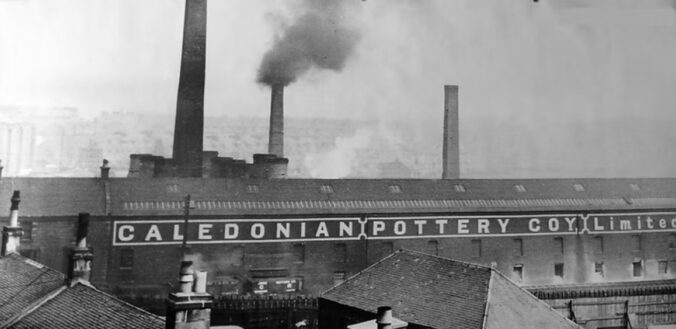
The Murrays were potters, but not just any potters.
Continue reading

The origins of Salisbury Quadrant, Nithsdale Drive and March Street

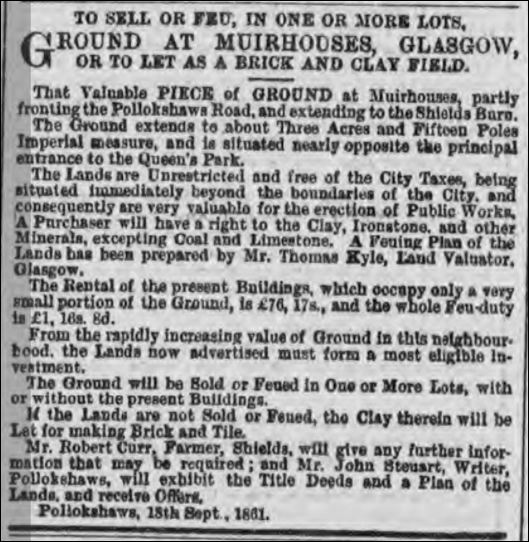
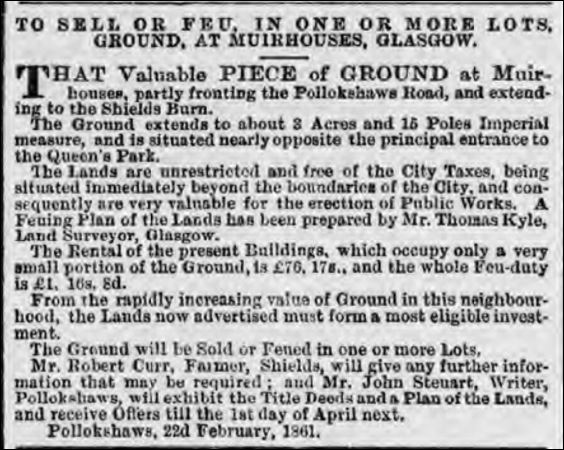
This short post was prompted by the discovery of an old advert from 1861 listed on the Scottish Brick History website, above. It describes the offer for sale of a plot of land at “Muirhouses”.

The land didn’t sell, and was advertised again in May 1862, with the additional option to use as a brickfield, or at least for extracting its clay.

Same advert except for addition of rights to the clay and to erect a brick field.

Advert in Glasgow Herald 6 May 1862, now advertising use as a brickfield. Source: Scottish Brick History

The Scottish Brick History site presumed it to be land used by William Wilson for a brickworks in Muirhouses, near Eglinton Toll , but it didn’t ring true. So where was it?

Continue reading

Scottish Cars & the industrial heartland of Titwood Road

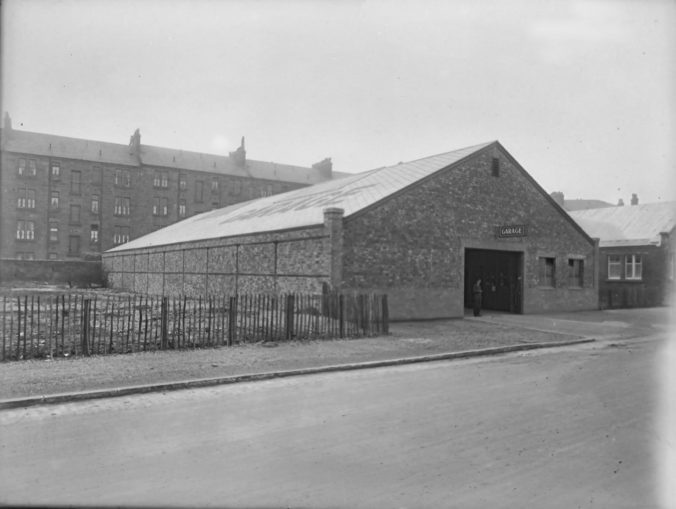
The last article in the series on Strathbungo’s commercial motor garages, but this one covers much more than just Scottish Cars. You wouldn’t believe it now, but Titwood Road was once a hive of industry, covering cars, photography, catering, indoor tennis, bowls, boxing, engineering, boot making, cold storage, veterans, and a large dairy. Almost all evidence of this has now vanished.

Titwood Road

Lane off Waverley Street, the original line of Titwood Road

Titwood Road was originally a farm lane that led over the railway where Crossmyloof Station now sits. The tenements of Waverley Gardens were built with their back courts facing directly onto the lane, but in 1922 the road was realigned a little further north, providing new plots for the Pollok Estate to feu on the south side of the road. At the Pollokshaws end, these plots were used for housing, as extensions of the Moray Park development of red sandstone houses by James Wright (Strathbungo’s Gardens) and the white houses of William Todd Aitkenhead (Carswell Gardens). From opposite Carswell Gardens up to Minard Road, the plots were all feued for commercial purposes.

Continue reading

« Older posts

© 2026 Bygone Bungo

Theme by Anders NorĂ©nUp ↑