
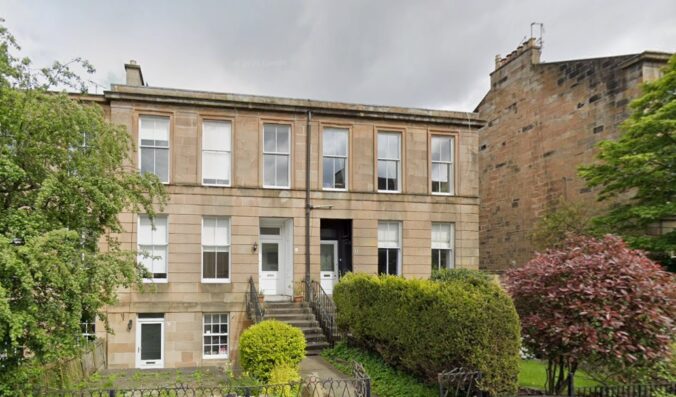
No 6 Queen Square was built around 1865-6 by Daniel McNicol, and was originally No 2, being renumbered to 6 around 1929. Note how 1 & 2 (now 4 & 6), being the end pair in the terrace, protrude very slightly forwards of the rest, a discreet end pavillion to break up the frontage. It occurs at the other end as well. Yet it is so subtle very few ever notice it.
Rev William Rossborough
The Rev Rossborough was the first occupant of the house, renting from Daniel McNicol from 1866 to 1873. He was born in Ballymena in 1813. His father was an elder in the Presbyterian church at Culleybackey, Co. Antrim. William also became a minister, at the 1st Presbyterian Church at Rathfriland, County Down, from 1837. In 1842 he married Margaret McAlester of Belfast, but she died in January 1847, and his father died the following day. In December 1848 he married again, to Magaret Allan, and had six further children, four of whom survived to adulthood.
In 1858 he gave up his ministry after twenty-one years and, partly with a view to the education of his children, accepted a call from East Campbell Street Free Church, Glasgow. A deputation had come from Glasgow to hear him and some other Irish ministers. In 1881, after twenty three years in Glasgow without missing a day from his work, he retired, first to Kirn, Dunoon, then in 1885 back to Belfast, where he died in 1892.
When in Glasgow the family settled initially in Monteith Row, but while there William lost his two children from his first marriage, and his youngest son from his second, which may have prompted his move to the suburb of Strathbungo in search of healthier surroundings. Nonetheless his second wife died at Queen Square in 1870, and in the 1871 census he was at 2 Queen Square with his four surviving children, Annie, Eleanor, Robert and Margaret. Around 1874 the family moved away from Strathbungo to Sandyford Place.
His daughter Annie married twice, the second time to Sir William McCammond, Lord Mayor of Belfast. Eleanor married John Thompson, a brickmaker in Belfast. Robert was a shale and clay specialist. His wife Edith was from Liverpool and the family was well-travelled, with children born in Cheshire, the Channel Islands, Belgium, Lanark and Dublin. Margaret married Walter Allison, a timber broker in Glasgow.
William bought a lair in the Necropolis when he lost his eldest son in 1863, and when he died in Belfast, his body was returned to Glasgow and he too was buried in the Necropolis .
The church was one of three on East Campbell Street, but has not survived, and I can find no picture of it .
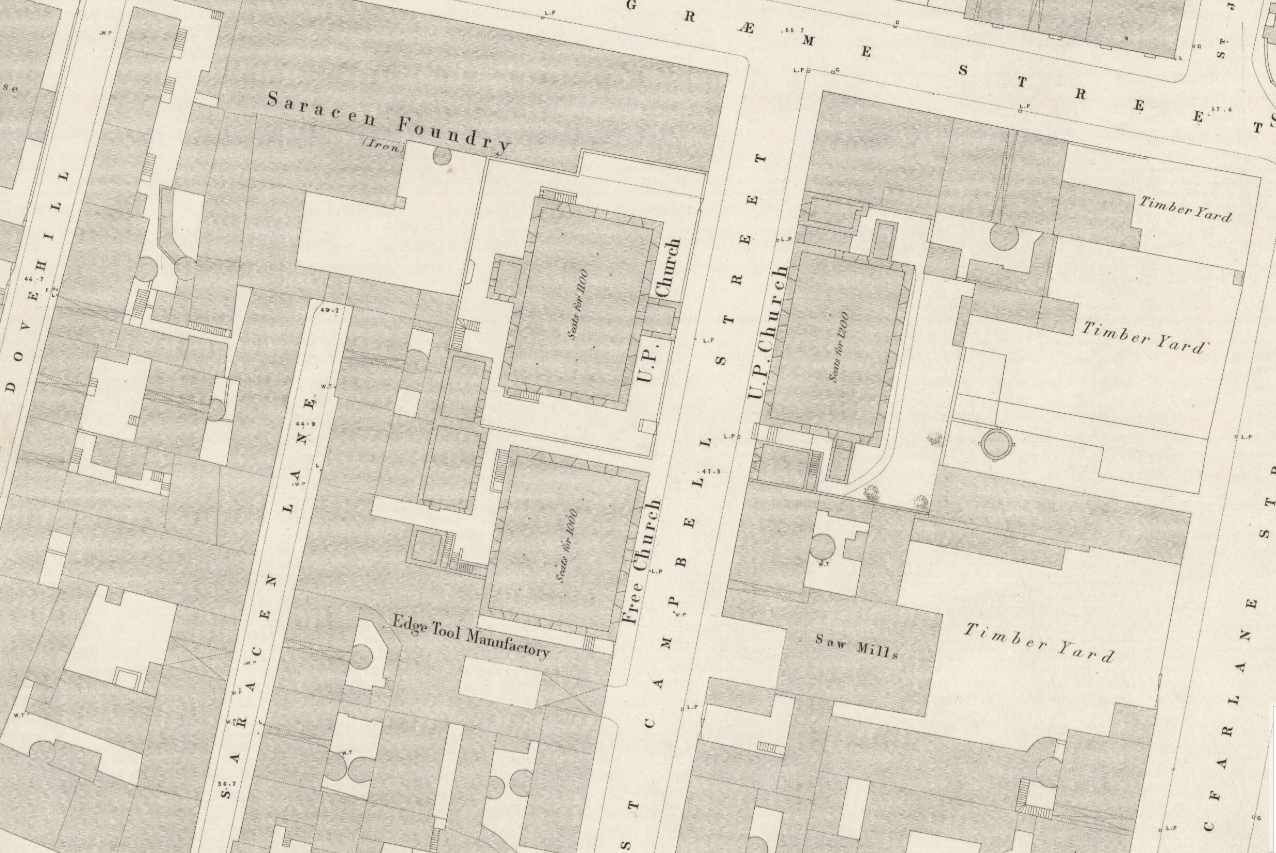
The OS Town Plan of 1860 showing the free church and two adjacent UP Churches. Note also William MacFarlane’s Saracen Foundry just opened in its original location, before it moved to Possil. Source: NLS Maps
George Smith MD
George Gregory Smith was born in Buckie in 1833 and trained in medicine at Marischal College, Aberdeen, before taking up work as a general practitioner, a chemist and druggist in Glasgow. He opened his first store in Stockwell Street circa 1854 and a second at 112 Renfield Street around 1866. He married Cecilia Murphy in 1859 and they had four children.
Two of the children were born in Strathbungo in the late 1860s, when the family were staying at 7 Regent Park Terrace (802 Pollokshaws Road). They later lived in Abbotsford Place in the Gorbals before moving briefly back to Strathbungo at 2 Queen Square around 1874-75.
In 1881 the North British Daily Mail reported his bankruptcy, partly blamed on the collapse of the City of Glasgow Bank, but primarily on debts in relation to maintenance of properties he owned in Stockwell Street, and loss of business at his shops .
David Bennie
David Bennie was born in Polmont in 1811. He married Elizabeth Hunter in 1833 and followed a varied career, working as a contractor in 1851, a colliery manager in 1861, and ironmonger in 1871. He founded David Bennie & Sons, a nail, bolt and chain manufacturer. He was living at Walmer Crescent in 1871, and lived briefly at 2 Queen Square around 1877-79. He later occupied Coplawhill House, a large (probably semi-detached) property later replaced by the telephone exchange on Pollokshaws Road at Coplaw Street. The building on the other side of Coplaw Street, the drill hall, was designed by the architect John Bennie Wilson, but I can find no Bennie link between them. David Bennie later moved to Kirkintilloch, where he died in 1888. His sons continued the business which apparently lasted into the 1990s.
The Dundee Advertiser reported a rather unfortunate industrial accident at the Bennie factory in 1897, when a worker was killed by a block of sandstone which fell on him. The stone had come crashing through the roof having been blasted out of the quarry next door .
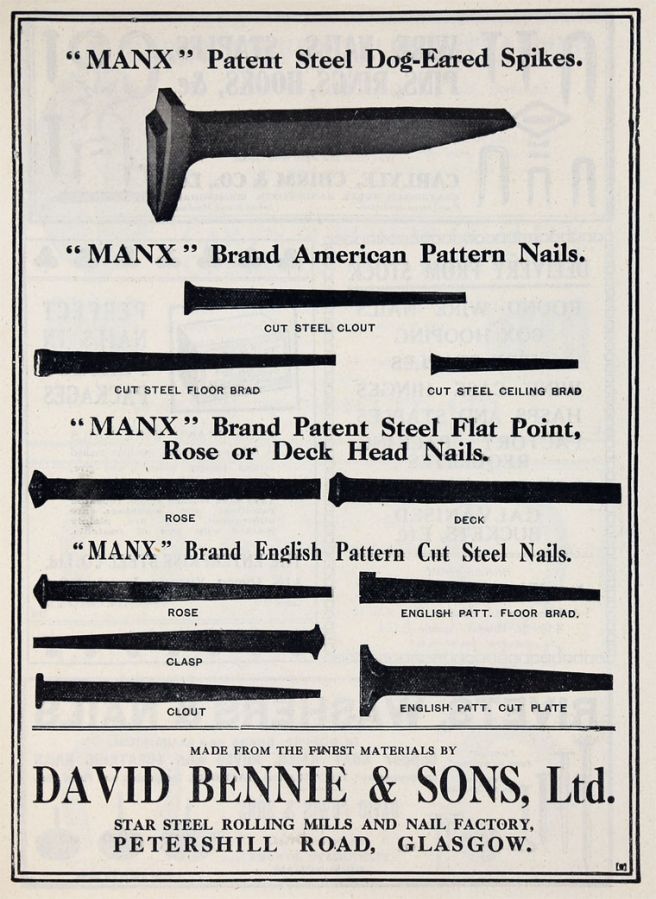
Advert for David Bennie & Sons, c 1921; the company continued many years after its founder’s death, and produced dog eared spikes for fixing rails to sleepers. Source: Grace’s Guide
Rev Robert McMillan
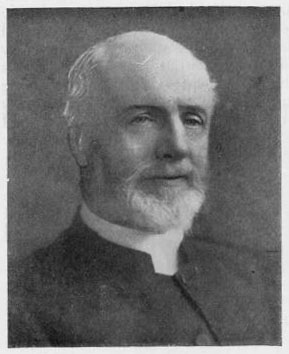
Rev Robert McMillan, 1876-1916
Robert McMillan was the second minister to reside in the house, and the first owner-occupier. He was born in Ayr in 1847, the son of an Irish cotton weaver. His father died in 1865, and by 1871 the family was living in Crown Street in the Gorbals and Robert was working as a missionary, presumably at Glasgow City Mission.
At first engaged in business in his native town of Ayr, he had thence proceeded to the ministry, and after the usual course of study at the University of Glasgow, was licensed by the presbytery of Glasgow in April, 1875. For about a vear he underwent training as a licentiate in the old Barony church, where his conscientious and able work was never forgotten. His “Bishop,” Dr. Marshall Lang, showed his continued regard and friendship through the succeeding years of his young assistant’s growing influence in Strathbungo. When ordained to ihe church, Mr. McMillan was still in his thirtieth year, and by the possesion of a deep religious experience, together with the boundless energy of youth, was able to face the_heavy task awaiting him on the south of the river. He was duly ordained to the church on 6th July, 1876.
He was a major figure in the development of Strathbungo Parish, and the building of the replacement church. His ministry is described in detail in the article, Strathbungo Parish Church and the 1933 book, Strathbungo and its Kirk, from which the above quote is taken.
When he moved from the Gorbals he first rented an apartment in 11 Regent Park Terrace (now 830 Pollokshaws Road), but around 1880 moved to 2 Queen Square. He purchased the house for £750.
On 19 April 1881 his boss, Dr Marshall Lang, officiated at his marriage to Mary Waddell in her home, 10 Moray Place. Mary was the youngest daughter of James Waddell, a wealthy coalmine owner who had recently acquired the Stockbriggs estate near Lesmahagow, but used 10 Moray Place as the family’s townhouse.
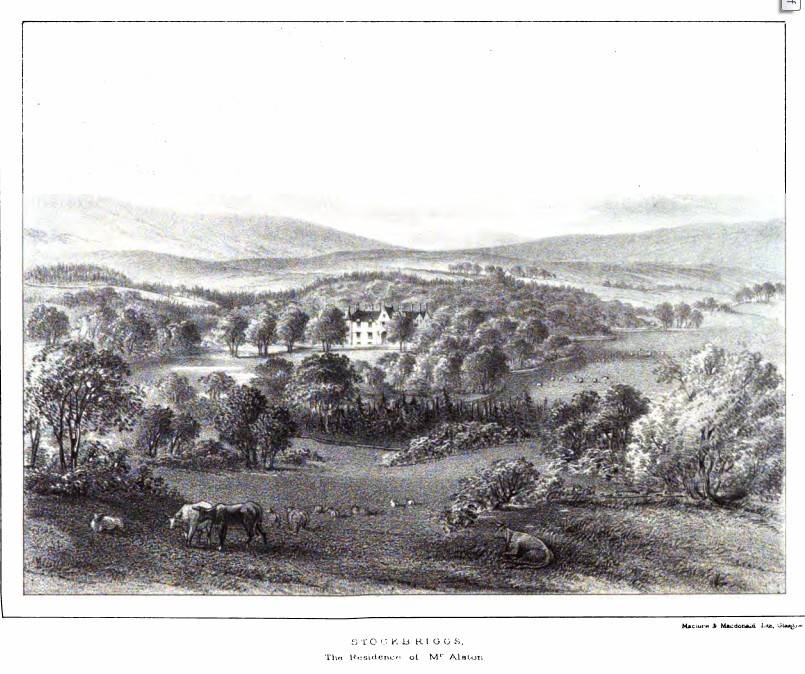
Stockbriggs Estate – home of James Waddell and his daughter Mary – Rev McMillan’s wife to be.
Robert’s mother died at Queen Square in 1882. His and Mary’s first child was born there ten days later, and a second in 1886, both boys. The eldest, James Waddell McMillan, would go on to inherit the coal business. There is more detail in the article about 10 Moray Place.
In 1889 the house was advertised for sale. Rev McMillan moved to Leslie Street and sold the house for £715 in January 1890. He continued his ministry until his retirement in 1916, aged 70. He died four years later.
Thomas Sinclair
The purchaser in 1890 was 47-year-old Thomas Sinclair, and though he was dead from pneumonia within 14 months, the house was to remain in the Sinclair family for the next 64 years.
Thomas was born in Glasgow in 1844. His father Robert was an Orkney-born writer (solicitor) and a procurator in Glasgow. The family lived at addresses in the Gorbals, but moved, like so many, to a newly built house in Strathbungo, at 15 (now 32) Regent Park Square. Thomas, the eldest son, also trained as a writer, and appears to have moved out at this time and stayed in the Gorbals. He married Janet Wallace Russell in 1871 and lived initially in Pollok Street, Tradeston, and later in Carment Drive, Shawlands.
He was a partner in the practice of Robert & Thomas Sinclair, of 12 Miller Street, a business that appears to have been named for him and his father, but subsequently included his brothers James and John, and his son Robert. His brothers later became Strathbungo residents also, James living first at 36 Nithsdale Road (1891) and from c.1895 at 7 (now 16) Regent Park Square, while John moved to 3 (now 8) Regent Park Square.
On Thomas’ abrupt death shortly after moving to Strathbungo, the house at 2 Queen Square passed to his wife Janet and their two children, Robert and Margaret. Robert died in 1916 (though I can find no official record of this) as his interest in the property passed to his mother and sister. Janet’s brother Wallace Russell was also living with them, but he too died at the end of 1916. Janet died in 1923, but her daughter remained in the property, unmarried. Wallace Russell and his father appear to have built and managed tenements in Crown Street, and this was the likely source of the family’s income. In 1952. aged 75, she defied death when she slipped on ice and was run over by a lorry, escaping with a broken arm . She passed away in 1954 and the house was then sold for £500.
Bert Lott
Bert Lott was the owner from 1954 to 1964. We have met him on these pages before – from the late 1940s Bert and Eunice Lott were tenants in the upper floor of 17 Regent Park Square, and Bert ran a taxi firm from the house, Bert’s Taxis, as advertised in the Jewish Echo. In 1954 he bought the house for £500, and in 1964 he sold it for £2250 and moved to Giffnock. This was the first significant increase in the house’s value in 70 years.
Etienne Lambert
The buyer was Etienne John Lambert, an airline sales rep of Titwood Road. In 1971 he moved to Surrey and sold the house to Eric Stern of Newton Mearns for £4000.
Eric Stern
Eric founded Hunter’s Car Hire on Dumbarton Road in 1962 with his wife Rica, hiring caravans and trailers , though I don’t know of his subsequent activities. He purchased the house in 1971 and spent heavily restoring the property and converting it to three flats for rent. In 1986 he sold to Leonard & Audrey Lee of Newton Mearns for £60,000. Audrey was his step-daughter.
Leonard Isadore Lee & Audrey Lily Lee
The Lees continued to rent the three flats. Following their passing the flats may soon be available to new owners. Who will continue the story?
Whoever that might be, if you would like the historical deeds back, let me know. Thanks to Trevor Lee for letting me look after them for now. These documents are so often binned by solicitors, but don’t let them; they are history in your hands.
The Deeds

The bundle of deeds and other legal documents relaiting to 6 Queen Square, rescued from the solicitor’s bin.
Much of this research is based on the remarkably complete set of deeds and numerous related legal documents that were passed to me. They also give an idea of how the Strathbungo houses were financed in the Victorian era. I include a summary here, for those interested in how house purchases used to work.
The house was constructed in 1864-65 by Daniel McNicol of Elgin Villas in Shawlands, who also built the houses in Regent Park Square at the same time. In the bundle of documents is a loan secured on the property to Daniel from Mary Gilmour, a farmer’s daughter in Neilston, at 5% interest (technically in Scots Law a “bond and disposition in security” by McNicol to Gilmour, the equivalent of an English mortgage). The housebuilding appeared to be funded by many such bonds, with each lender being a private individual, who therefore had a legal interest in their particular house in the terrace.
In 1867 Daniel repaid the loan, but took a further £600 loan from a Mary Allison of East Kilpatrick. This loan was in turn sold in 1872 by Miss Allison (by then she was Mrs Turner, and a farmer’s wife in Kirkintilloch) to John Brown, a draper at 71 George Street in Glasgow, who promptly sold it on to the trustees of the late Dr James Brown Wharrie, a doctor in Hamilton. Around this time Daniel McNicol died, and the debt passed to his trustees, who were James Davie, shoemaker (Daniel’s wife’s brother), Rev Robert Stewart of St Marks, James McNicol, house factor (his son) and James Wilson Stevenson, house factor. (Not related. Cross check with Builders of Strathbungo). The loan passed to Dr Wharrie’s children when the last of them came of age in 1878.
In 1884 McNicol’s trustees sold the house to James Anderson, a tea merchant in Glasgow, but he had sold it on to Rev MacMillan before he even obtained the title, so Rev MacMillan paid the trustees £150 and took over the debt (so buying the house for £750). The documentation of this also contains the only reference to McNicol’s purchase of the plots on which to build. It notes payments to William Stevenson, the original purchaser of the Strathbungo land, of £1200 in November 1865, £1700 in May 1886 and £600 in August 1866, though it isn’t clear if this covered just the Queen Square terrace or the two in Regent Park Square also. These were all paid off in November 1867.
in 1885 John Brown Wharrie died, and the bond was reassigned to his brothers and sister, all resident in Edinburgh.
In 1890 Rev MacMillan sold to Thomas Sinclair for £115 and the debt, a loss of £35 in six years. Sinclair paid off £100 of debt, and the remaining £500 bond was sold by the Wharries to James Kemp, a gas fitter and plumber in Dumbarton Road. Sinclair died the following year and the house passed to his wife in liferent, and children. They then paid off another £125 to James Kemp.
In 1916 the Sinclairs paid off £25 to Mrs Agnes Farquhar or Kemp, executor (and widow) of James Kemp, who had died in February, though during that process Robert, Thomas’ son, died. The rest of the bond, £350, was transferred to William Neilson, an accountant & house factor in Glasgow. In October there was a memorandum of understanding to sell the house to Mrs Annie McIntyre or Barlow of Somerset Place, Glasgow, with consent of her husband John Barlow MD, but it appears this sale never went through.
In 1934 a further £150 was paid off by Miss Sinclair. She then assigned the property temporarily to William Hall Sutherland, a property agent of 205 Hope Street, but this appears to have just been security for a £600 loan, which she repaid in 1937.
In 1954 Miss Sinclair died, and her trustees (which included her property agent at 205 Hope Street) sold it for £500 to Bert Lott. In 1964 it was sold to Etienne Lambert for £2250. Lambert took a mortgage for £1200 from the Woolwich Building Society at 6% to fund it. In 1971 it was sold to Eric Stern for £4000, and in 1986 to the Lees for £60,000.
It is fascinating to note that the £500 purchase price in 1954 was less than it was worth in the 1890s, yet around thirty years later it sold for £60,000 and is now worth ten times that.
Additions and corrections welcome, as always.
Leave a Reply