
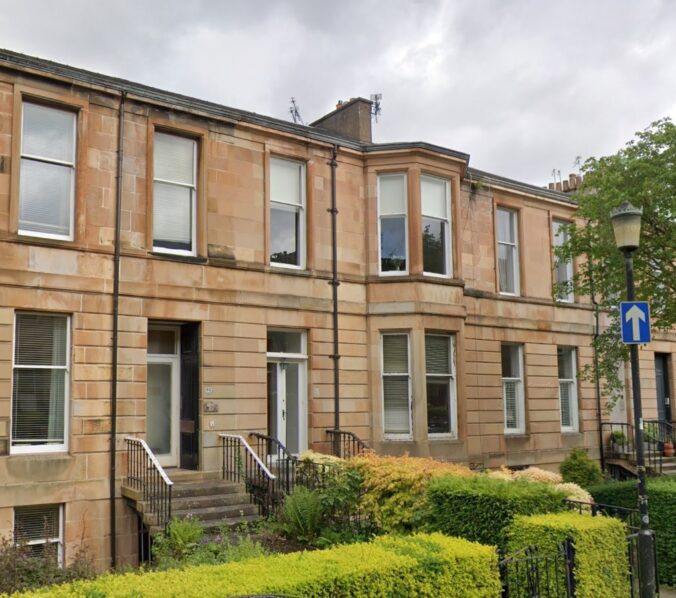
This is the story of the occupants of 12 Marywood Square, and formerly known as 5 Princes Square. The terrace was built by Robert Weir in 1878-9 but the project led to financial ruin and Robert’s tragic suicide. The houses and debts passed to his father William, but the family never recovered, as detailed in this blog about the Weirs.
William Fenton
Once the terrace was complete in 1879, the first tenant was William Fenton, a wholesale jeweller with premises at 15 Gordon Street. He didn’t get an auspicious start in Strathbungo however; he was declared bankrupt in June of the same year . In July he failed to turn up for his bankruptcy proceedings and an arrest warrant was issued . No more was heard of him.
Robert Samuel Fischer
The next tenant was Robert Samuel Fischer.
Fischer was an intriguing figure. He was in the house by 1881, as he appears in the census, though how long he stayed is unclear; no resident was recorded in the PO Directory for the next ten years, and neither did he appear anywhere. His low profile means that, other than him being a warehouseman, we don’t know his line of business, who he worked for or where he worked. Fortunately, we can learn something about him from Ancestry records and contemporary newspapers.
Robert was born in the City of Hamburg in 1841, but was in Cincinnati, Ohio, by 1850. A quarter of Hamburg burnt down in the great fire of 1842, rendering 20,000 homeless, but it is more likely the failed revolutions of 1848 that aimed to unify the German states led to his emigration. Huge numbers of revolutionary supporters were expelled or left for overseas, collectively known as the “forty-eighters”. One popular destination was Cincinnati, where so many Germans settled north of the Miami Canal that the canal became known as the Rhine, and the northern district as Over-the-Rhine, a title it retains to this day. It is estimated at one time half of the city spoke German .
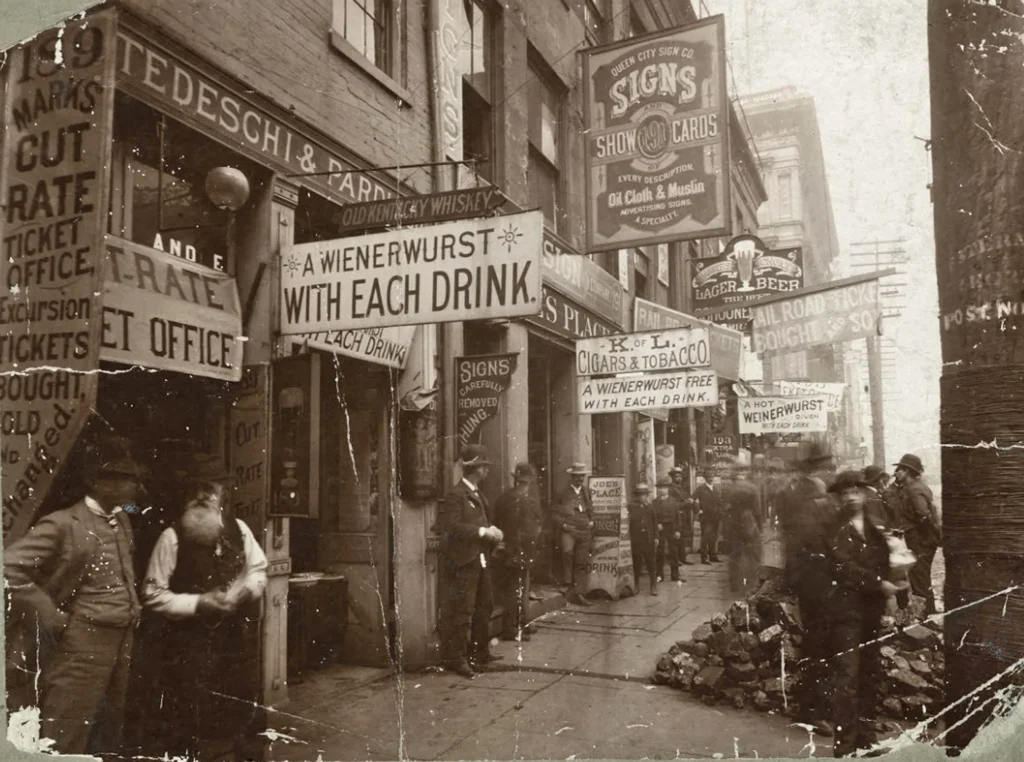
Fifth and Vine streets had plenty of saloons offering a wienerwurst with each drink to attract German customers. Source: Cincinnati & Hamilton County Public Library
Not everyone welcomed this influx however. On election day 1855, the 1850s version of Reform, the Know Nothing Party, rioted in Over-the-Rhine and destroyed ballot boxes over claims of voter fraud. To defend themselves, the German residents formed a militia unit, built a barricade across Vine Street and rolled out a cannon. The riot ended the Know Nothing influence in Cincinnati .
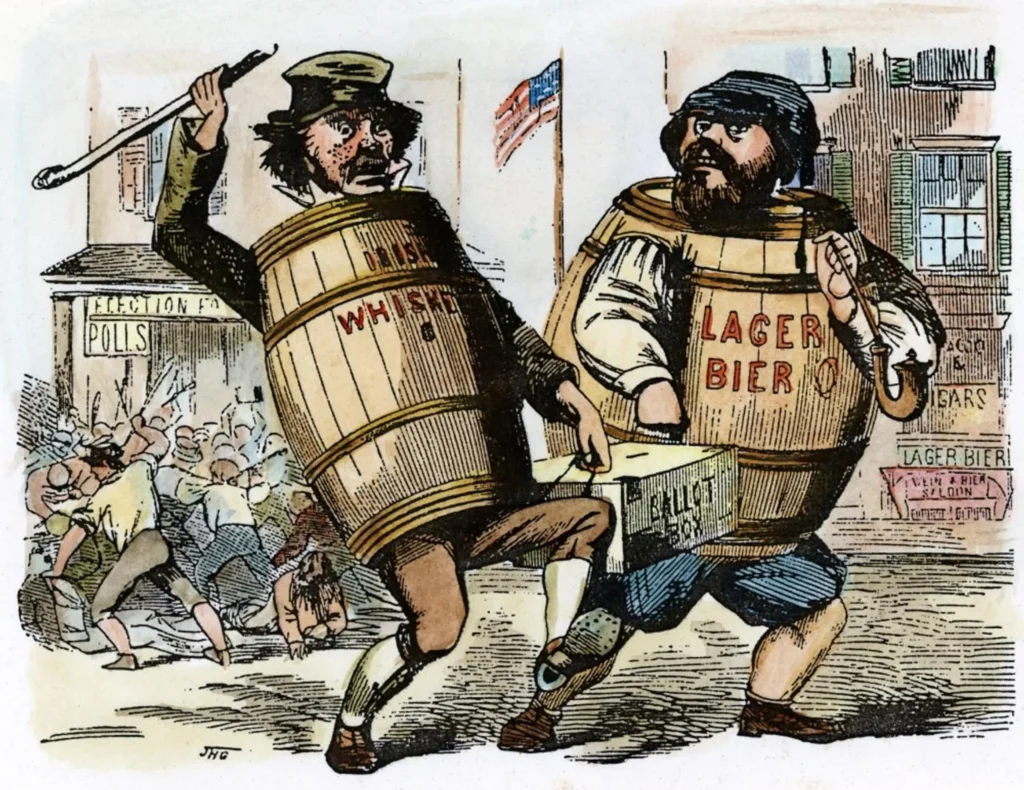
A political cartoon from the 1850s by John H. Goater depicts Irish and German caricatures “stealing an election,” feeding into the anti-immigrant and anti-Catholic views of the Know Nothing political party. Source: Cincinatti Enquirer/Public Domain
We don’t know whether anti-German feeling was a factor, but for whatever reason, he didn’t stick it out in Ohio. He next popped up in Manchester, where he married local girl Catherine Lord in 1868. They had three children, Bertha, James and Robert, between 1868 and 1876. in 1871 he was working as a clerk in a shipping warehouse and the family was living in Moss Side. In 1876 he became a naturalised British citizen, and in 1879 he was described as a “Foreign Correspondent” in Slater’s Directory of Manchester & Salford.
In 1881 he appears again in the census, but now he is living at 5 Princes Square, Strathbungo, with his wife, three children and a domestic servant, 21 year old Elisabeth Clarke Hamilton. He is listed as a merchant.
The persistently empty PO Directory listing suggests he stayed there 10 years, but by the 1891 census he was at 42 Nithsdale Road managing a shipping warehouse. His wife is absent, and there is another young servant, Annie Campbell, 22, of Kentra, Ardnamurchan. From 1894 he was renting at 12 Millbrae Crescent.
Robert was also a Swedenborgian.
The Swedenborgians
These were the followers of the teachings of the 18th-century Swedish scientist Emanuel Swedenborg, though they preferred to be known as the New Church of Jerusalem. Swedenborg was a polymath, a philosopher and later a mystic, after God invited him to freely visit heaven and hell and converse with angels and demons. More reasonably he also thought it wasn’t enough to believe to achieve salvation; you had to do good through charity as well.
I don’t even begin to understand the differences of thought that gave rise to this curious branch of religion, but it was popular in the later 19th and early 20th century in Britain. What little information I can find in relation to Glasgow refers mainly to the New Church erected in Woodlands Road in 1909, but the first proper New Church in Glasgow was actually on Queens Drive at Niddrie Road, and built twenty years earlier (1888-9). It was designed by local architect John Bennie Wilson, and has now been converted to flats.
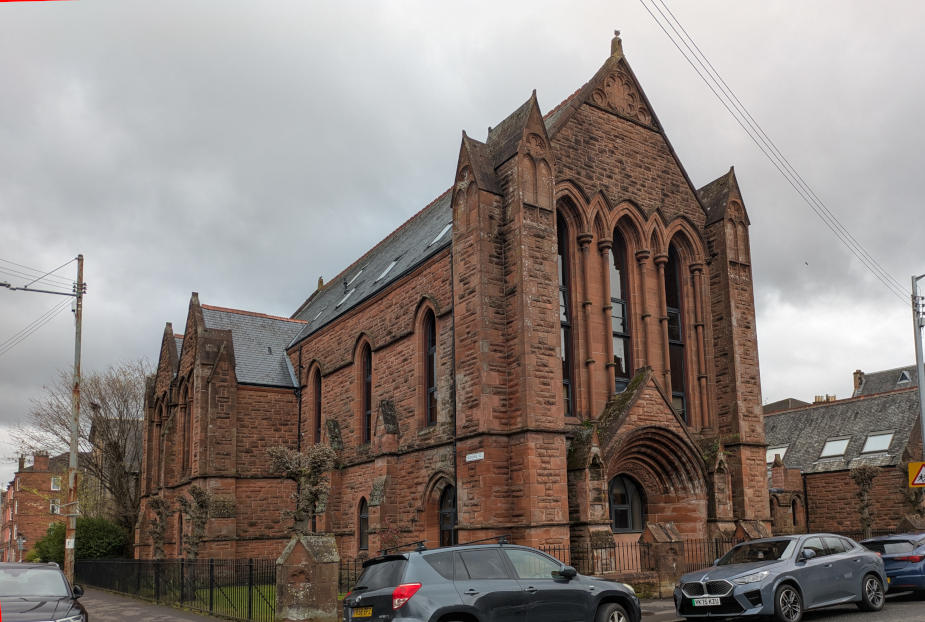
The former Swedenborgian New Church of Jerusalem on Queens Drive.
Robert Fischer was certainly a follower; in 1881 he chaired the meeting of the Scottish New Church Association, then just a year old, in Alloa. The church was in its infancy in Scotland, with work in Alloa, Edinburgh, Glasgow, Paisley and Greenock, but few or no churches of their own (apparently they had previously bought a Methodist Chapel in Paisley in 1860; it only closed in 2019). Their activity is well described in a report in the Alloa Advertiser . Two years later Fischer was himself President of the Association, no less .
I can’t find a direct link between him and the Queens Drive Church, but I presume he was involved in its founding.
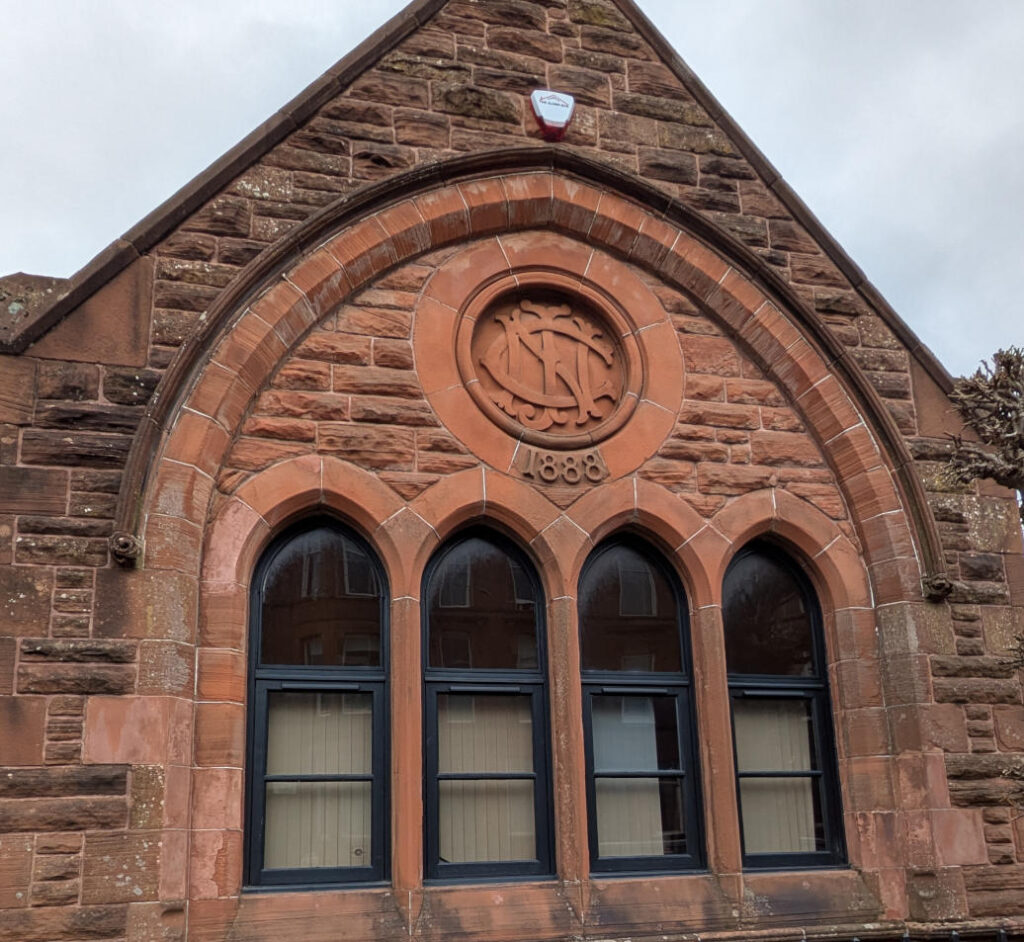
The church hall roundel says NJC, with the date 1888 below.
His daughter Bertha married Louis George Hoeck in 1894 and started a family. Louis was a lawyer from Paisley, of German descent, and an accomplished cello player .
The family were all on holiday in Stonehaven in August 1897, by which time the Fischers were apparently living in Dundee, the Hoecks were in Paisley and Louis was now a Reverend, and James Fischer had moved back to Manchester where he became a linen and cotton merchant .
Some time around 1900 the Hoeck family migrated to Cambridge, Mass so Louis could enrol in theological college, and by 1907 he was a minister in the New Church of Jerusalem in Cincinnati. There he served until retiring in 1938. He died in 1952, and Bertha passed on three years later .
Robert then appears to have moved back to Manchester, although maybe just visiting his son James, before emigrating back to the USA in 1908. He travelled from Liverpool to New York aboard the SS Cedric, the largest liner in the world at the time of its launch. He was described as 4ft 11in, with dark eyes and a ruddy complexion. He was destined to return to Cincinnati, where he stayed with his daughter Bertha and her husband Louis. The two men became significant figures in the American New Church movement, and published a summary of Swedenborg’s commentary on the psalms in 1910. It means nothing to me, but if you want a read, the Mitchell Library has a copy!
It isn’t clear what happened to Catherine, though Robert was a widower by the 1910 US census. Their other son Robert joined the army and was sent to India, where he married.
Elizabeth Clarke Hamilton
Elizabeth was the Fischers’ domestic servant at 5 Princes Square in the 1881 census. I can’t always trace servants, but this time I was in luck. Elizabeth was born to John and Mary in Stonehouse in 1859. John was a postman. In 1886 she married Andrew Binnie, a railway inpector, and they had three children, but Elizabeth died of renal failure in 1900. She was 41.
William Ramsay
From 1892 to 1895 the occupant was one William Ramsay, Jnr. He was born in the Gorbals in 1853, the son of William Ramsay of Fife, and followed his father into the ironmongery business. His father may have been the owner of an ironmongers in Cupar (also styled as William Ramsay Jun) in the 1850s, although he was already living in Glasgow by then. With business doing well, the family had moved from the Gorbals to Dunedin Villa on Albert Drive (now Road) in Crosshill by 1861.
From 1881 to 1900 he had a business in Argyle Street, William Ramsay Jun & Co, ironmongers, brass finishers, gas fitters and lamp makers. By 1886 he was in another property known as Dunedin, this time on Newark Drive in Pollokshields. His father died there in 1888.
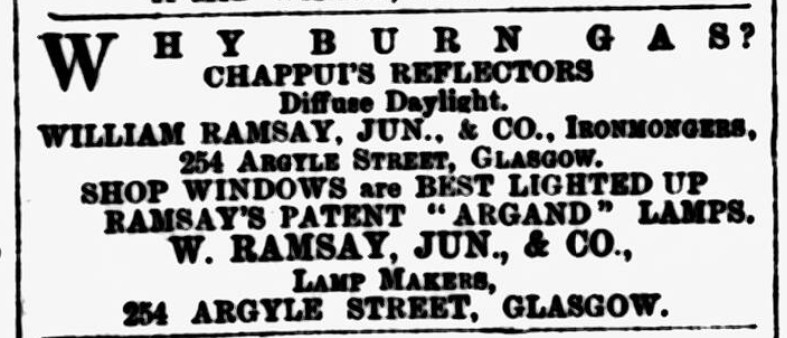
Advert for William Ramsay Jun & Co, Helensburgh News Feb 1886. Source: BNA
His business sold various light fittings, including Chappuis’ patent light reflectors, silvered mirrors that reflected light into dimly lit offices, saving on gas lighting. They were very popular from their invention in the 1850s until electric light became readily available .
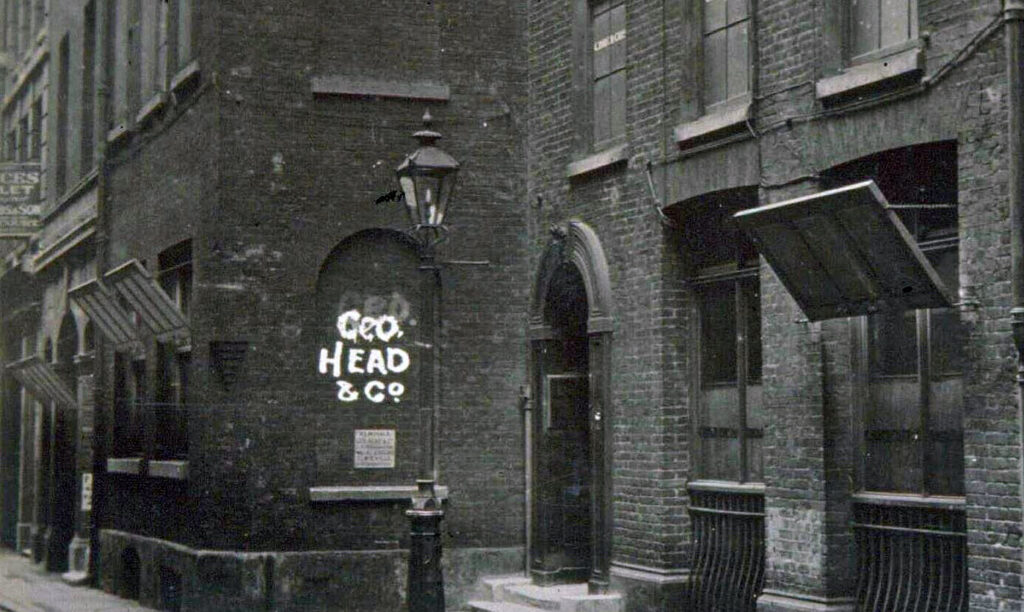
A London back alley with Chappuis’ reflectors installed. Source: ianvisits.co.uk
He provided the wall lights for the University building on Gilmorehill, and in 1891 repaired the large brass eagle lectern in the cathedral after vandals broke in and smashed it .
He moved to Princes Square with his English wife (Emma? Eliza?) around 1892, but curiously there is no record of their marriage, nor of any children. He went bankrupt in 1900 although he was subsequently descharged of his debts in 1902 and the couple spent their remaining years at Berlin Terrace, Leven Street until they vanished from the record around 1906.
George Burrell Ramsay
William’s younger brother George (1855-1935) grew up with him in Crosshill. George never lived in Strathbungo himself, but he is well worth a mention. He picked up a love of football as a lad, being in the vicinity of Queens Park and Third Lanark just as the sport was taking off. He moved to Birmingham around 1875 to work as a clerk in a brass foundry. Soon after arriving he joined in a kick-about in a park, and being not bad, was invited to join a fledgling team who called themselves Aston Villa.
He introduced the Scottish passing game to the English, leased their first ground so they could charge admission fees, and before long he was the captain. He retired at 27 after an injury but in 1886 was appointed as the club secretary, and once in post he effectively invented the role of the football manager. In his 42 years in charge, Villa won six league titles and six FA Cups, and became the premier English team. They have never quite managed to achieve the same heights since he left .
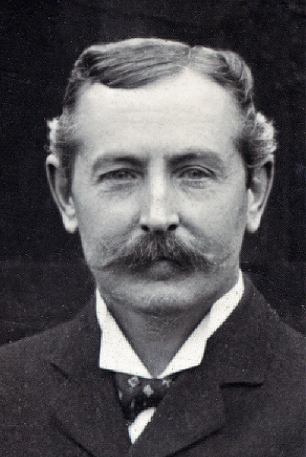
George Burrell Ramsay, Aston Villa Manager c 1905, from a team photo. Source: Wikipedia/Public Domain
George Ferguson
George Duke Ferguson (1860-1956) moved in in 1895 and stayed until the early 1900s. He was a soap manufacturer, like his father, and grew up in his father’s house at 6 Moray Place. There is already a full description of the family in that blog post, including George’s involvement, and the use of their grease to launch the Queen Mary!
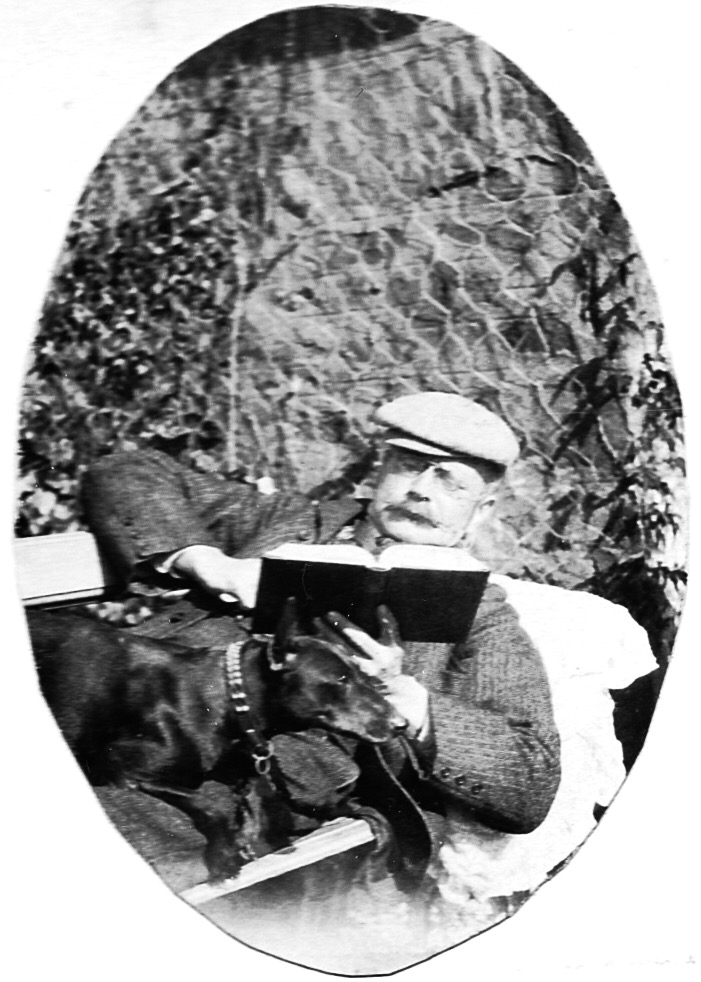
George Ferguson with Prince the dog. Credit: Linda Gerardi
George studied law, but after his father’s death in 1878 he continued to live at Moray Place into the 1890s with his brother John, and sisters Annie and Alice. He married his housekeeper, Margaret Muir Turner, in 1895 at the Grand Hotel, and rented 5 Princes Square. He was there in 1901 with his wife and two servants, Jane Nicholson and Ryeburn J McMillan. By 1903 they had moved to North Kelvinside. Margaret died in 1917 and he didn’t marry again. He succeeded his brother John as a senior partner in Ferguson, Shaw & Sons. He retired in 1953 at the impressive age of 92 and died in Troon.
The first servant appears to have been Jane Nicolson, a shepherd’s daughter from Dollar, Clackmannanshire. One of nine children, she was in service in 1901, but the following year became the second wife of recently widowed Alexander Goodwin, a railway clerk in Alloa.
“Ryeburn J McMillan” (from the census transcript) is likely Jane Raeburn McMillan, who was born in 1881 to Malcolm and Margart McMillan. Malcolm was a coal miner in the Shotts area. Again from a family of nine, she married John Henderson, an engine fitter, in 1902. Sadly she died of TB in 1916. She was 35.
George D Stirling
George was the first recorded owner-occupier of the house, from 1903 to 1913. He was a chartered accountant at John Wilson & Stirling of 145 St Vincent St.
He was the youngest of nine children of James and Abigail Stirling. James was a minister in his home town of Kirriemuir for many years, but when he died in 1870 the family moved to Glasgow, settling first in Dixon Avenue, and later at 31 Regent Park Square (now 23). John died there at a young age, and Robert moved away and founded a furniture business before returning to Strathbungo to live at 25 Moray Place (now 52 Marywood Square). When their mother died in 1880 four of them, including George, were still living in Regent Park Square in 1881, along with two young nephews, possibly orphans.
George married Janet Gemmell in 1892 and they resided at 5 Princes Square from 1903 until his death in Rothesay in 1913. They appear to have not had children.
William & Jessie Seaton
William was born in Bridgeton in 1858 and married Jessie Grainger in 1884 in Cathcart. They had three children. The couple purchased the property (in her name) and were resident from c. 1913 to at least 1927. William was another one who didn’t always appear in the PO Directory, but was a partner in Seaton, Turner & Co. The firm ran tea rooms, including The Cabin at 105 St Vincent Street in the 1890s, and the City Cafe, at 41 West Nile Street, in 1915, but the latter business was put up for sale in 1916 and continued under new owners. He described himself as a tea dealer and tea room proprietor. He died in 1930, one street over at 31 Queen Square. His wife lived on there for some years but died in 1941 in Pollok.
The notable designer cum architect George Henry Walton designed some of Smeaton’s tea room interiors in 1898, as well as Miss Cranston’s establishment in Buchanan Street. He also worked closely with Frederick Rowntree, a Strathbungo-based architect.
M Dixon
M Dixon was resident in 1930, but again didn’t have a proper listing in the PO directory, so I can’t identify them. The address was, briefly, 12 Princes Square; after renumbering but before renaming of the street.
The Goldsteins
In 1935 the Directory records at 12 Marywood Square Mrs G Goldstein, and V. Goldstein (Mantles) Ltd, a mantle (women’s cloak) manufacturer of 57 Ingram Street. The company was founded in July 1934 by Gertrude Goldstein herself, a tailoress, with Laura Sandground, and capital of £1000. But it’s all a bit odd; Victor Goldstein, Mantle manufacturer, was being wound up in September the same year. Was the business being transferred from husband to wife just before the husband went bust? By 1938 they had vanished, although the voters’ rolls suggest they moved to Cathcart, and Gertrude survived into the 1950s, latterly in Herriet Street.
Additions and corrections welcome, as always.
Leave a Reply