
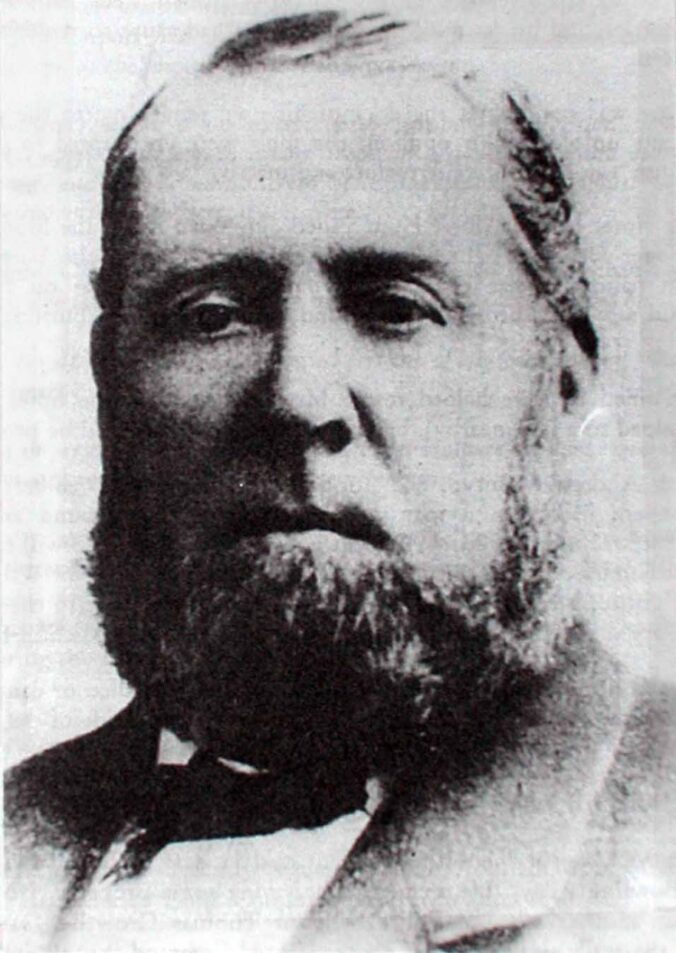
I have now identifed and described almost all the builders of Strathbungo’s iconic buildings, but Andrew McIntyre’s fascinating story deserves an account all its own. As it is Australia Day today, 26th January, it seems appropriate to document a Strathbungo man’s role in riot, insurrection and the democracy movement in Australia.
But first the Strathbungo stuff.
Andrew McIntyre was the youngest child of Archibald McIntyre, a mason from Glenorchy. The family moved from Callander to Glasgow around 1825 and Andrew was born there in 1831. He married Margaret Kerr from Beith in the Gorbals in 1850 and moved in with her family at 80 Eglinton Street. They were both 19.
By this point his two brothers John and George, who were several years older, were already establishing themselves in their father’s trade as masons, and would go on to become brickmakers and builders. John McIntyre, the eldest, would partner with the quarry master William Stevenson and architect Alexander “Greek” Thomson to build Queens Park Terrace, and then purchase and develop Strathbungo, building 1-10 Moray Place, and possibly 11-18 also.
Andrew would eventually become a builder too, commencing in the 1860s. He partnered with southside brickmaker Alexander Thomson (no relation) and Robert Boyd in the Garscube brickworks, New City Road, around 1864 with a view to erecting tenements on Garscube Road, and they built the Cross Arthurlie mill in Barrhead in 1866, for example .
He took over the construction of the Greek Thomson tenement Titwood Place on Nithsdale Road after his brother John died in 1872. It was completed in 1877.
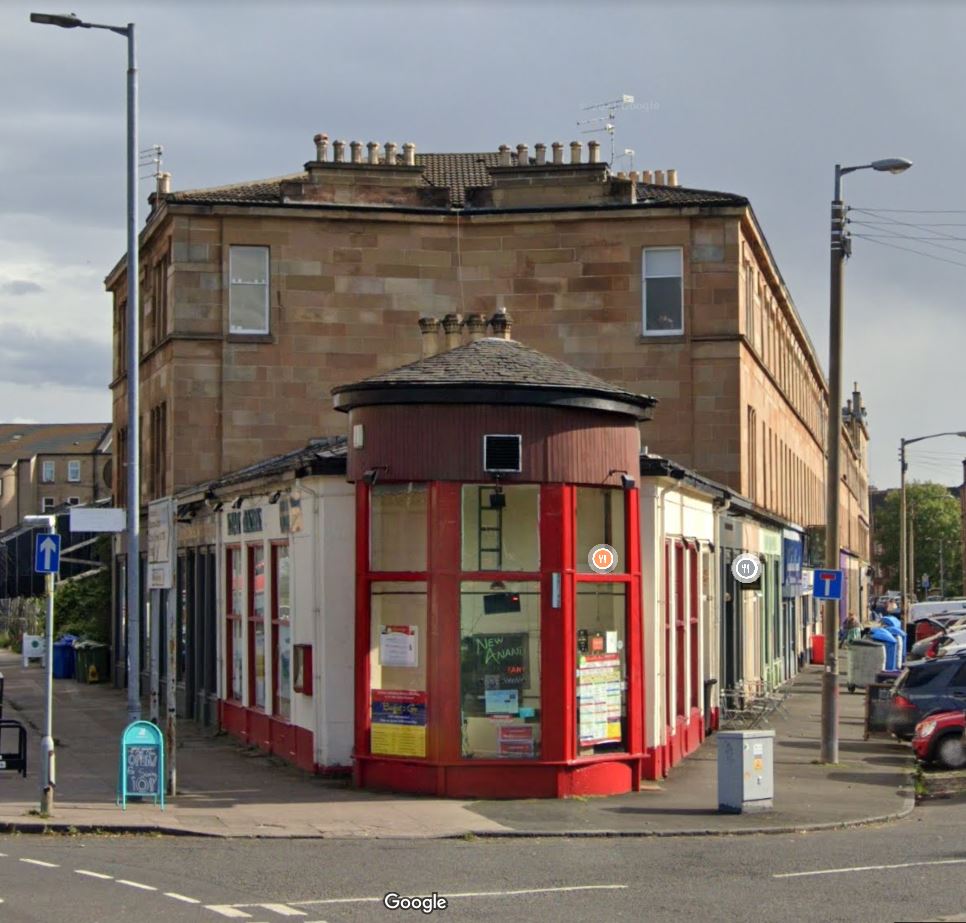
Turnbull’s unusual gushet of shops at the end of Matilda Place. 1 Matilda Place, now 65 Nithsdale Street, is to the left, and 9 Matilda Place, later 70 Nithsdale Road, and the rest of the terrace is to the right. Source: Streetview 2020
He later purchased the land for Salisbury Quadrant in 1880 and the building was completed after some unexplained delay in 1885. He briefly lived at 2 Salisbury Quadrant when it was completed, but not for long as he died in August 1885 while on a visit to Bute.
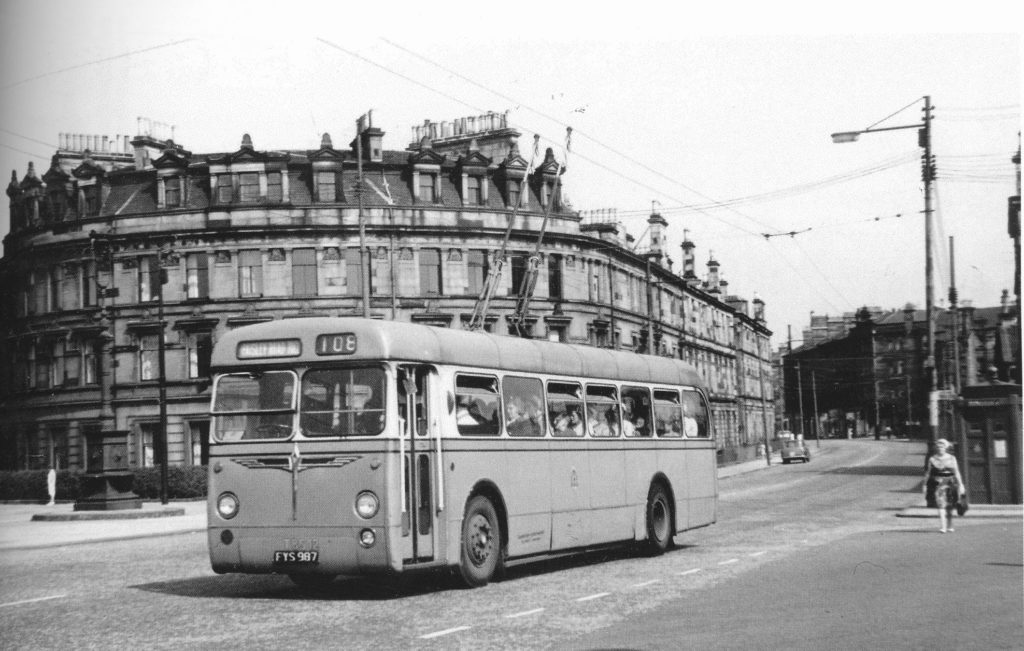
Trolleybus TBS12 on route 108 passes Andrew McINtyre’s Salisbury Quadrant on 8th August 1963. Image: Charles Billette, reproduced with permission.
But Australian Democracy?
So this is where it gets interesting. Missing from the above is any account of the 1850s. After marrying Margaret in 1850 and having a young child in 1851, he disappeared from Scotland for the next eight years.
Andrew initially saw a different path to wealth and success from that of his brothers. Young, just married, and with a new baby, Archibald, he did what any sane person would do – he took his family off to Australia to join the Victoria goldrush, live in a tent and become a prospector!
By 1854 he was an established miner in the Eureka goldfield, east of Ballarat. But the miners weren’t happy. The gold rush had brought a huge wave of immigration into Victoria state with the associated demands on local infrastructure, and the coffers were bare. The government sought funds through issuing miners’ licences at 30 shillings per month, and fining anyone found not to have one; with six months in jail for a second offence. This was strictly enforced by regular raids, and a miner could be prosecuted even if he had a licence, if he failed to produce it on demand. The population at Ballarat had risen to 20,000 by 1854 yet they had no political representation.
Charles Hotham arrived as Governor in June 1854, and alarmed at the depleted Treasury, pushed the police to redouble their efforts to collect fines. Given there were payments available for grassing on other miners, there was extensive corruption, and the police officers were mostly ex-convicts from Tasmania, this only added to the mistrust .
The murder of James Scobie
That summer James Bentley, another ex-convict from Tasmania, opened the commodious Eureka Hotel, with its adjacent bowling alley, but it rapidly gained am unpleasant reputation, as did Bentley. It also became a favoured drinking hole of local officials. On 6 October a Scottish miner called James Scobie was murdered outside the Hotel. It appears he tried to gain access to a lock-in after hours but was rebuffed. He may have broken a window, but was then apparently struck over the head with a spade, and died of his injury. Bentley was the prime suspect, but was believed to be financially intertwined with the authorities. One in particular, Police Magistrate John D’Ewes, had ensured Bentley got his licence, and may have been part-owner of the hotel. The inquest the following day found insufficient evidence against Bentley and he was allowed to go free, sparking outrage.
Next, on 10 October, a trooper arrested and beat up Johannes Gregorius for not having a licence. He was a disabled Armenian assistant to the local priest and was visiting a sick miner in his tent. When it was pointed out as a church servant he didn’t need a licence, he was charged instead with assaulting the trooper, despite his disability and clear evidence it was the other way around. He was fined £5. This was considered a direct insult to the church as many miners were Irish catholics, and discontent continued to mount.
The miners, fully aware of Bentley’s links to the authorities, demanded a judicial inquiry to review the murder. Under pressure, Gold Fields Commissioner Robert Rede, his assistant James Johnston and magistrate D’Ewes held the inquiry on 12 October. At the inquiry Scobie’s friend gave evidence:
Deceased went up to one of the windows and asked to get in and a blow was struck at the head of the Deceased through the window as if by a man’s hand. I was knocked down before I could distinguish who struck me… my eyes were attracted towards him [Bentley] because he was the only person I saw with a weapon in his hand
D’Ewes was observed to be hostile to prosecution witnesses yet courteous to the defence. During an adjournment Bentley spent 10 minutes in private in D’Ewes’ office, and D’Ewes then announced Bentley was innocent and could be discharged, much to everyone’s astonishment. That even included Assistant Commissioner Johnston, who disassociated himself from the verdict.
The Eureka Hotel riot
The miners called a series of open air meetings over the ensuing days to plan further action, culminating in a gathering of many thousands of miners outside the Eureka Hotel on 17 October. The meeting broke up, but in the evening there were still many angry miners present (sources vary from 1000 to 30,000!). They surrounded the hotel, but Bentley made it away to the safety of the Commissioners on one of their horses.
And in steps Andrew McIntyre. We are fortunate to have his own account from a letter he wrote to his brother-in-law in March 1855, but which was only rediscovered in 1996 .
Andrew had intended to go to the meeting, but had actually been too busy running repairs down the hole on his claim. He climbed out on hearing the commotion caused by Bentley’s flight. The Commissioners were at the hotel windows, trying to pacify the crowd. McIntrye himself:
…mounted one of the windows alongside the Commissioners, and was cried upon by the diggers to speak, I spoke for a few minutes against the conduct of the officials on Bently’s examination, but never said, nor never had any intention to advise them to take the law into their own hands. In the confusion and noise, they may have misunderstood me, however before I got done Bottles, stones, Books and all sorts of missiles came flying at the Commissioners’ heads, Resident Commissioner Reed Robert Rede then handed me his whip and requested me to try and get them to desist.
Fire soon broke out, however, and Andrew attempted to put out the flames, burning himself in the process. Dedes told him “I can swear you have done your duty like a man”. He helped save some belongings, and guard them afterwards, but within half an hour the hotel was reduced to ashes and the belongings were later torched as well.
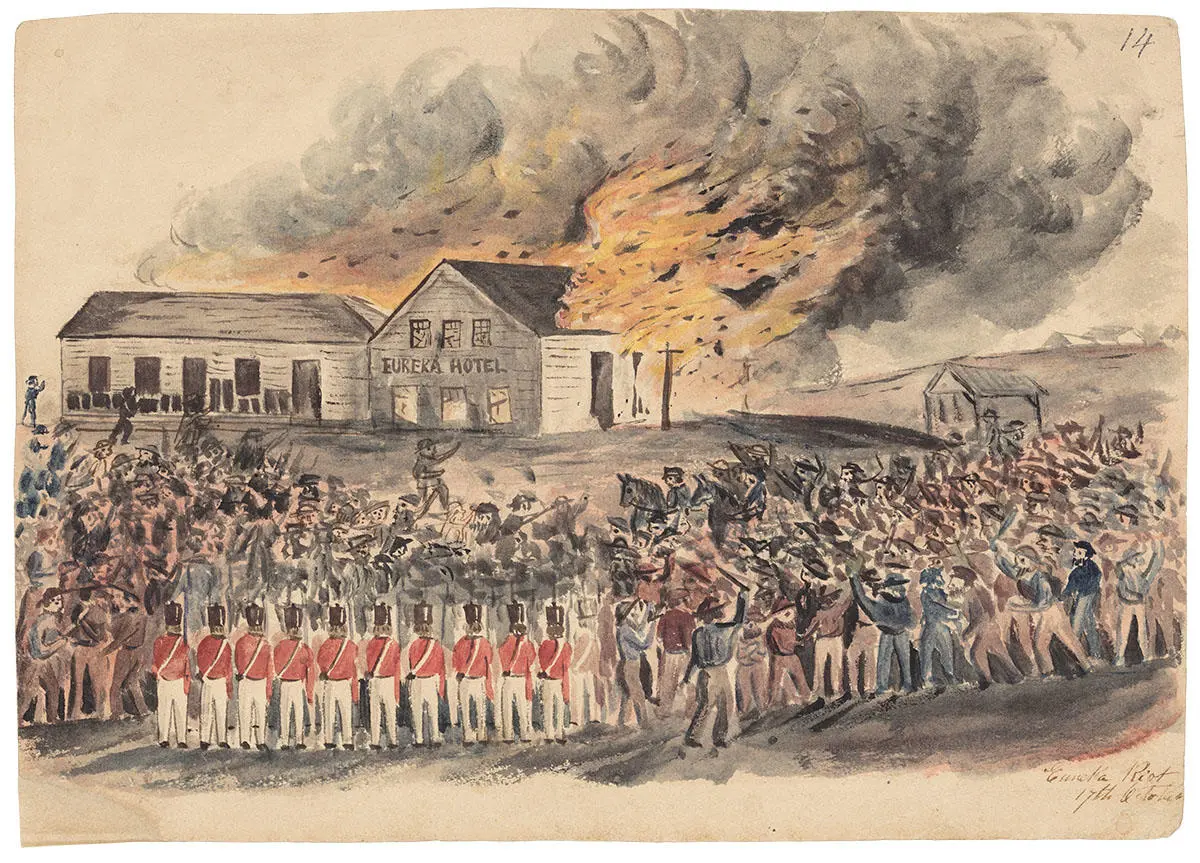
Eureka Riot by Charles A Doudiet, depicting the burning of Bentley’s hotel. Source: Art Gallery of Ballarat
Andrew had “a nibble of rum with Mr Reed and Capt Carter”, then set off home. Two police sergeants tried to arrest him, but he resisted, as they had no warrant. The next day he met Reed and the Captain, and they advised they had nothing against him. Additional troops were called from Melbourne over the next couple of days, and word got back to him he was to be arrested again and he was advised to flee. He remained at home (a tent on his claim, presumably with his wife and by now two children) and awaited events. The police and soldiers duly arrived on the 21st October at 2am, and he left them outside the tent before emerging at 4am and inviting them in for something to eat – one has to admire his spirit in adversity! He found 10 detectives, the Sergeant Major of Police and three troops of mounted police outside, there to prevent him being rescued.
Twelve individuals in all were arrested for their part in the riot, but only three, McIntyre, Thomas Fletcher and Henry Westerby, were charged. When word got out of his arrest several thousand miners surrounded the government camp, but were repelled by soldiers with fixed bayonets. Random strangers raised the £1000 bail to get him out pending a trial, and given the size of the mob, the authorities hurriedly released him. The miners offered to carry him out shoulder high to an accompanying German brass band, but he advised them to desist.
The trial of McIntyre
On the 25th McIntyre and Fletcher set off to trial in Geelong with their witnesses, flying silk flags with the words “Liberty” and “Justice for All” upon them, only to be told the trial had been moved to Melbourne. They returned to Ballarat, where the miners offered to take them into hiding. They travelled to Melbourne in time for a trial on 20th November.
Bentley and his associates were eventually retried in Melbourne, and having been found guilty, on 20 November were sentenced to three years hard labour. That same day D’Ewes was dismissed for accepting bribes to issue licences at Ballarat. That might have placated the miners, but for the fact McIntyre and co were tried the same day.
The trial ran from 10am to 9pm. McInyre’s letter seems to imply he would have got off easily given the strength of his witnesses, but for his counsel who made too much of a political argument out of it, pleading the burning was justified rather than calling the witnesses who would have said he didn’t do it. The next morning McIntyre was sentenced to three, Fletcher to four and Westerby to six months in jail. The judge spared them hard labour given their good character and the jury held that the authorities were largely responsible for what happened.
A week later, on 27 November, a deputation met with Governor Hotham demanding the release of the three prisoners. Hotham took great offence at the use of the word “demand” and refused their pleas, saying due process had been observed. The next day he sent more troops to Ballarat instead, only for them to be attacked by the miners, and their baggage train looted.
The Eureka Stockade
On 29 November the deputation reported back on their meeting to another large gathering of 10,000 miners, and proposed a mass burning of miners’ licences. This was also the first occasion of the raising of the new Eureka flag, hastily designed by Canadian miner Henry Ross, “made and wrought by English ladies”, and featuring the white Southern Cross with stars at its points on a blue background.
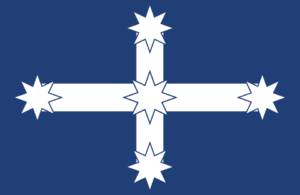
The Eureka flag design
The Governor ordered another vicious licence hunt the next day, with inevitable conflict given many had burned them. The soldiers used guns, bayonets and swords on those miners refusing arrest, and fired volleys over the heads of the crowd. Some miners obtained arms in response. They marched to Bakery Hill and elected Peter Lalor as their leader, and he asked them all to swear allegiance to the new flag: “We swear by the Southern Cross to stand truly by each other and fight to defend our rights and liberties.”
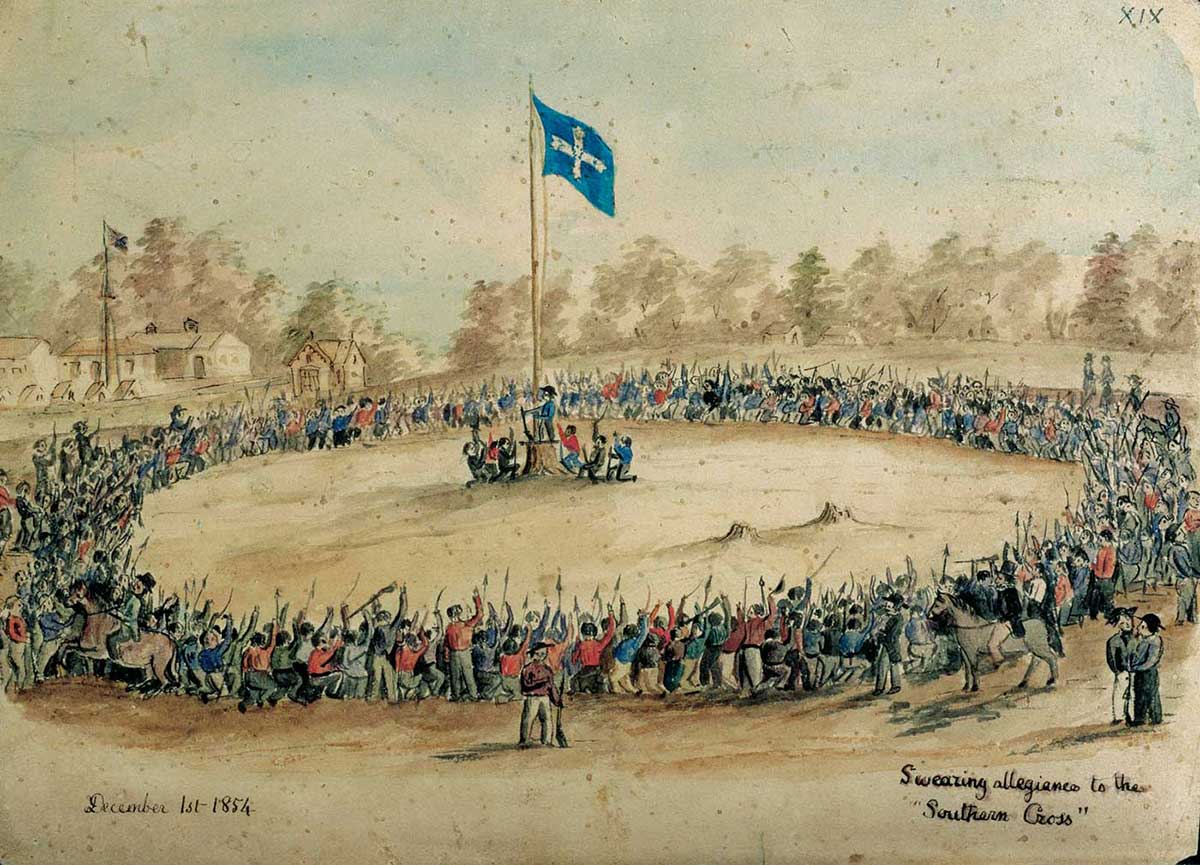
Swearing Allegiance to the Southern Cross by Charles Doudiet 1854, but only rediscovered in 1996. Source: Art Gallery of Ballarat
Another deputation went out, demanding the release of the latest arrested miners from the licence hunt, but were rebuffed by Commissioner Rede, who said this was “only a cloak to cover a democratic revolution”. Like Hotham, he also objected to the use of the word “demand”.
The miners hastily assembled an acre of ground at Eureka and built a large wooden pallisade, the Eureka Stockade. Up to a thousand gathered inside, some with rifles. Military drills were undertaken. However discipline and numbers dwindled, especially on Saturday night as miners returned to their families for the Sabbath, and by early morning on Sunday 3rd December numbers inside had fallen to around 200. The Government saw their opportunity and marched almost 300 troops to the site, and charged at dawn. After some deadly exchanges of fire, they overran the stockade and the battle was over in 15 minutes. The first shot from the rebels had killed the commanding officer, Capt Wise, and between five and eight of the soldiers were killed in all. The number of casualties amongst the miners is less clear, at least 22 but probably many more. They were said to be all men, but according to one report a woman pleading for the life of her husband was butchered by a mounted trooper.
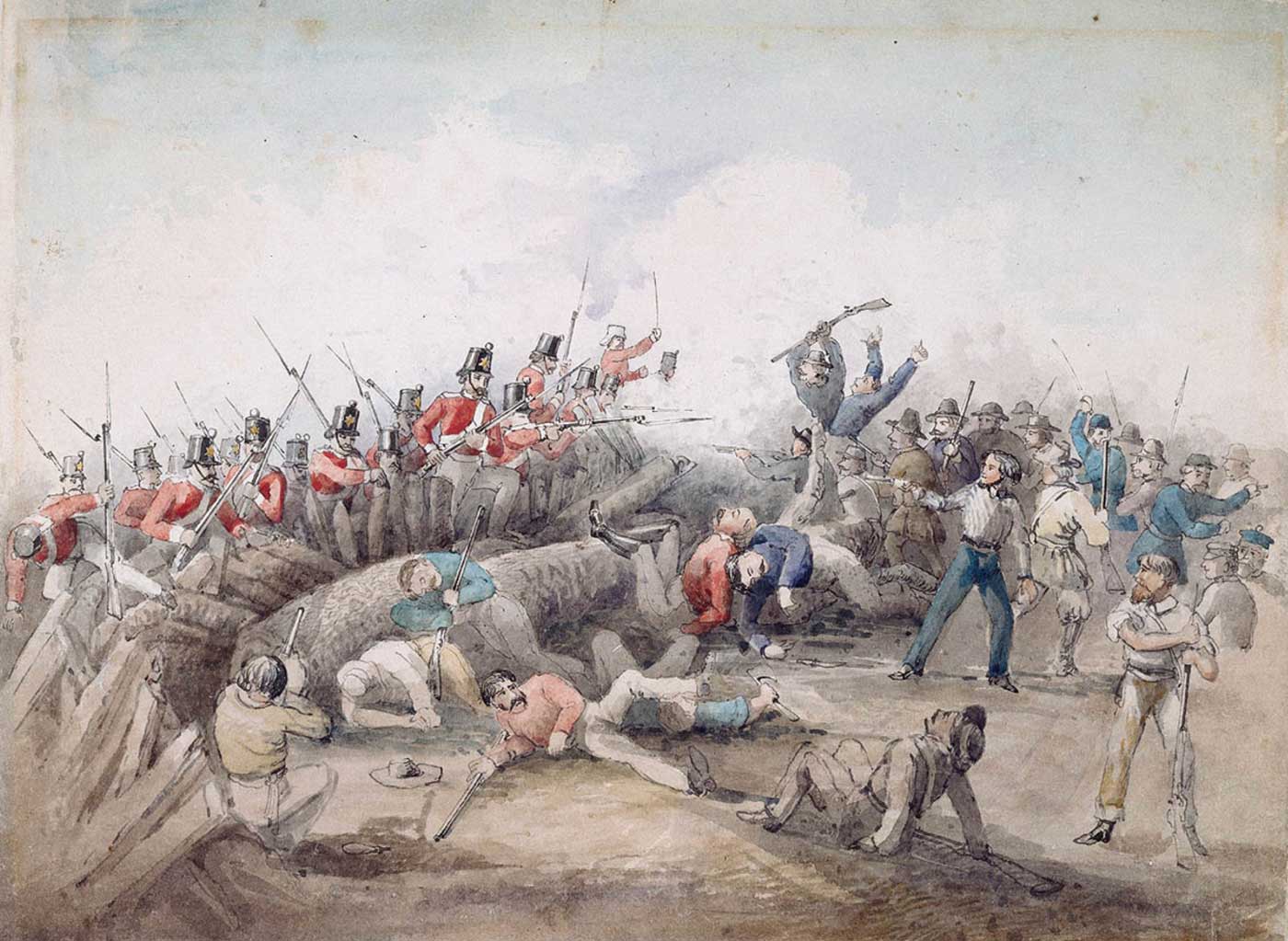
Eureka Stockade Riot by John Black Henderson (1854). Source: State Library of New South Wales
Aftermath
Troops detained 113 miners, and eventually 13 were taken to Melbourne to stand trial for High Treason. However the citizens of Victoria were as horrified by the behaviour of the authorities as the miners, and at their trials in February and March they were all acquitted one by one. A Royal Commission was established in March to investigate the miners’ grievances, and changes were introduced.
Rebel leader Peter Lalor lost an arm to a bullet but escaped the stockade, and following reforms, was elected to the Victoria Legislative Council.
The dismissed corrupt police magistrate John D’Ewes had already left Ballarat by the time of the stockade, taking his 14-year old pregnant new bride with him. He secured the job of postmaster at Victoria, Vancouver Island in British Columbia, despite an overlooked bad reference, and “maintained his reputation with the public for being attentive, energetic, and most obliging in carrying out the functions of his not very enviable office.” That is, until the auditor arrived three years later. D’Ewes had conveniently taken a shooting excursion up country before he arrived. He never returned and abandoned his wife and children. He was found to have embezzled £1000 from the Post Office. Six months later the local paper reported he had “committed suicide by blowing out his brains, at Homburg, a watering place in Germany.” What an all-round fine character .
While McIntyre was in prison his wife gave birth to their third child, in the tent on his claim. She was named Margaret Eureka McIntyre, and would later become Lady Margaret Fairweather. McIntyre was released in March 1855 and remained in Ballarat for a few more years. He returned home via Liverpool on the SS White Star in January 1859. With him were his wife Margaret, and three children Jane, Margaret Eureka and John Bryce McIntyre. Oddly Archibald, then 8, wasn’t listed, but he was safely back with them in Glasgow in 1861.
Historical significance
I had not previously heard of the Eureka Rebellion. I discovered the story by accident when trying to track down the source of his portrait. However an Australian friend tells me the Eureka Stockade is well known to all Australians, and often taught in schools. While some historians play down its importance, others suggest this was a defining moment in the development of Australia. Doc Evatt, leader of the Australian Labor Party in the 1950s, stated that ‘Australian democracy was born at Eureka.’ The discovery of McIntyre’s letter gives a much clearer idea of his role than previously available.
The Eureka flag remains a well-known symbol of protest to this day, adopted by republicans and trade unionists.
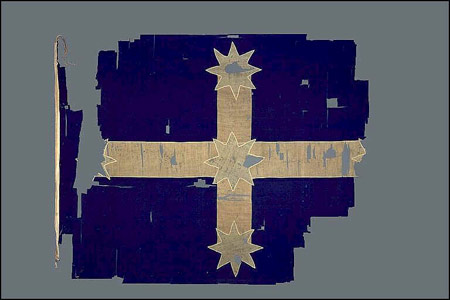
The remnants of the original Eureka flag, as retrieved by police trooper King and later donated by his family. Source: Art Gallery of Ballarat
So there you have it, a Strathbungo builder’s crucial role in the birth of a nation – well sort of. For a Strathbungo builder’s crucial role in the development of Sydney, you need a different article about the Howies. Co-incidentally their tenements face each other across Nithsdale Road. Perhaps it should be renamed Aussie Street.
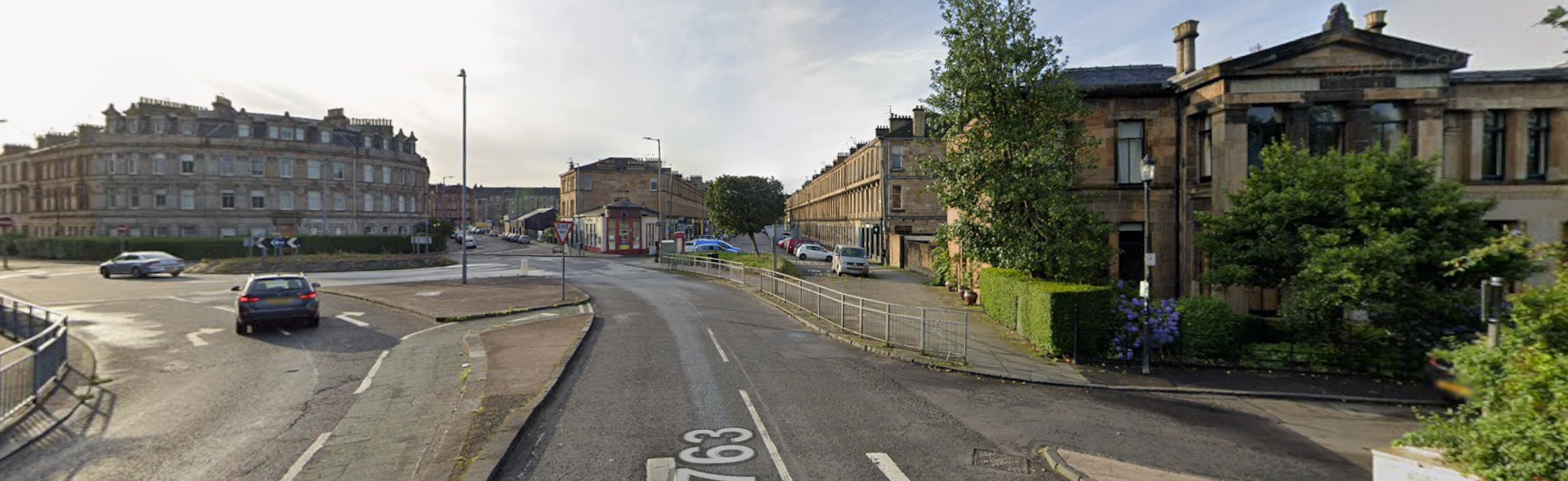
View of the Australian quarter of Strathbungo, from the railway bridge. John McIntyre’s 1-10 Moray Place is on the right, Howie & Sons’ Matilda Terrace on Nithsdale Street, Andrew McIntyre’s Titwood Place facing it across Nithsdale Road, and turning in to Nithsdale Street, and McIntyre’s Salisbury Quadrant to the left, between Nithsdale Street and Nithsdale Drive. Source: Streetview
I struggled to find a single coherent description of the events described, and so have assembled the above account as best I can from a number of primary and secondary sources .
Leave a Reply