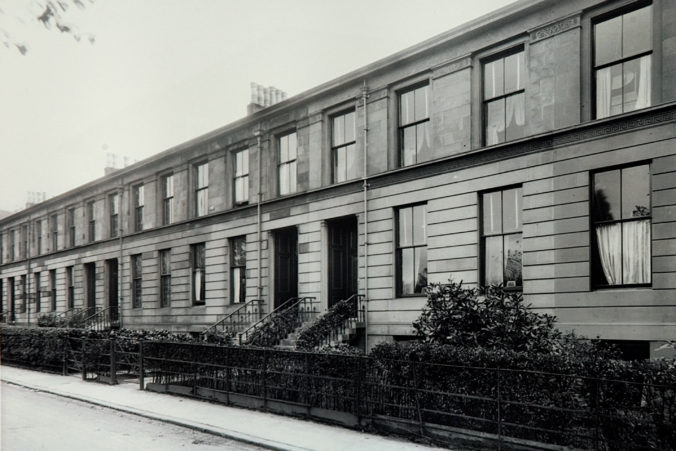
The story of the former inhabitants of 24 Moray Place wanders amongst sugar refining, Britain’s first diesel engine, the curious origins of a famous Irish song, the dangers of Australian bushrangers, the origin of Scottish turntable ferries, Confederate gun-running, the loss of the SS Atlantic, an episode of Taggart and more.
Robert Andrew Robertson
The first occupant of 24 Moray Place, from 1874 to 1876, was Robert Andrew Robertson, an engineer.
Robert was born to Andrew Robertson and Isabella Riddell. His father was from Kelso, but moved to London. At the time of Robert’s birth on 23 April 1843 Andrew was working at Islington Preparatory School as the arithmetical and writing master.
Robert was baptised at the National Scotch Church (“The Caledonian Church”) in Regent Square, just two weeks after the Great Disruption of 1943 that saw the Free Church including, I think, this London congregation, split from the Church of Scotland.
Robertson appears to have been known professionally as “R.A.” or Andrew, rather than Robert. I have used “R.A.” to avoid confusion with his father and son, both Andrew Robertson.
He served his apprenticeship with Messrs. James Simpson & Co., pump manufacturers of Pimlico. In 1864 the manager there, David Thomson, took him to South Staffordshire Waterworks in Lichfield, where he carried out some extensive tunnelling operations to supply the expanding Black Country industries and population with fresh water .
From 1866 to 1872 he was Manager, for Mr James Duncan of Greenock, of the Clyde Wharf Sugar Refinery in London, where he developed his extensive knowledge of the handling of sugar which would serve him well in later years. The refinery was ultimately not a huge success, going bankrupt in 1886 and later burning down, but it was the first of several that developed in Silvertown, East London. The Tate & Lyle refinery still operates there to this day .
He was elected an Associate of the Institution of Civil Engineers on 2 March 1869, and elevated to Member on 14 May 1878.
He married Elizabeth Ritter of Melbourne, Australia, in 1870 in Greenwich.
Around 1874 R.A. moved to Glasgow to take up a post at Mirrlees, Tait & Watson, and for a short period settled at 24 Moray Place. He already had five children and within three years he moved to 42 Aytoun Road in Pollokshields, and later as his success continued, to Park Circus. He would ultimately have at least 12 children.
Continue reading
Like this:
Like Loading...


Recent Comments